
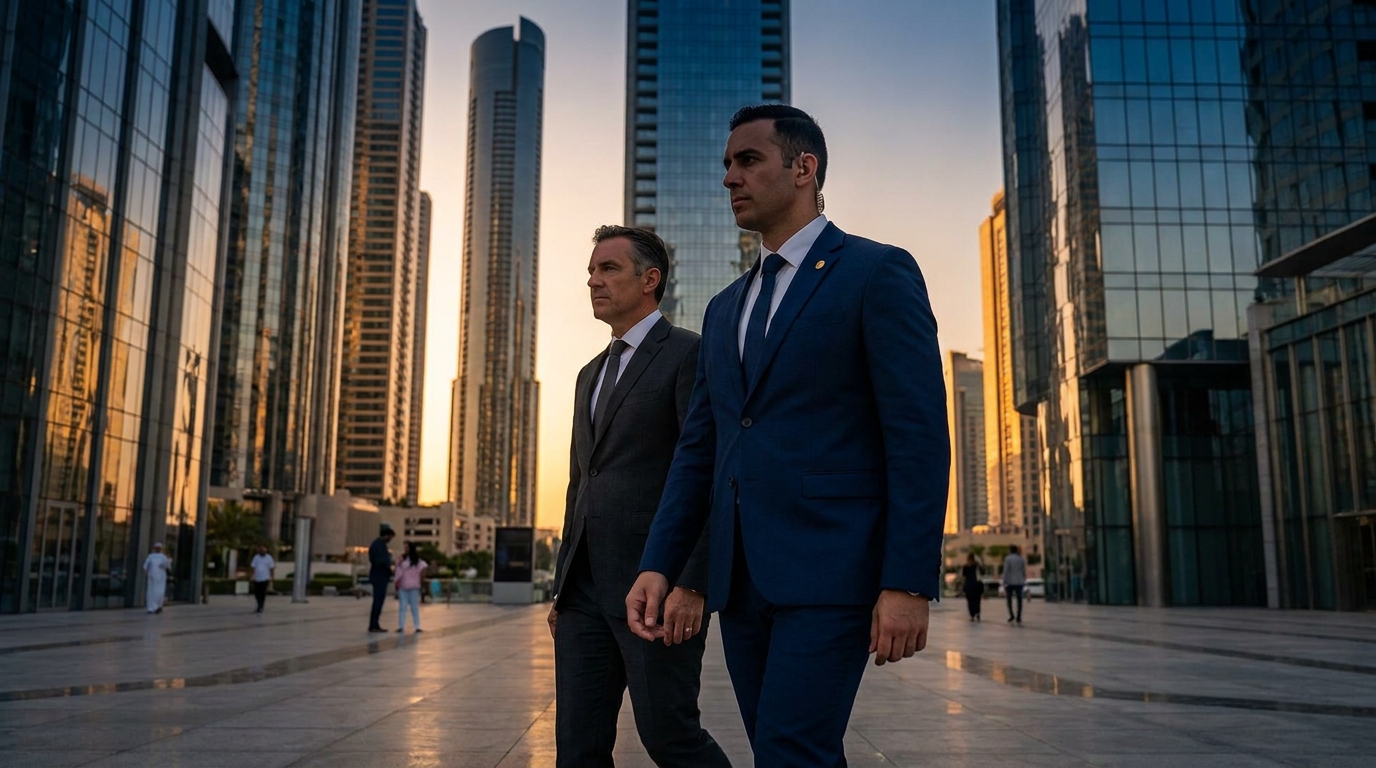
Most people searching for close protection services in Dubai are approaching it from the wrong direction. They ask: “What does a close protection officer do?” The better question is: “What does the principal’s life look like with good close protection in place – and what goes wrong without it?”
This guide is written for principals. Not for CPOs, not for security consultants trying to justify fees. For the executive, the HNWI, the family, or the advisor who needs to make an informed decision about whether close protection services are warranted – and what to demand from a provider.
What Close Protection Actually Is
Close protection isn’t a bodyguard standing behind you at dinner. that’s a caricature built by film and television. In professional practice, close protection is an intelligence-led, operationally managed programme that surrounds the principal’s movement patterns with layers of planning, information, and trained response.
The core disciplines are:
- Advance work – the CPO or advance team surveys venues, routes, and locations before the principal arrives. They identify exits, parking exposures, crowd chokepoints, and local threat actors.
- Route planning – primary and secondary routes are identified and assessed daily. Static routes are avoided; pattern-of-life predictability is your biggest vulnerability.
- Counter-surveillance – trained operators monitor the environment for individuals or vehicles displaying surveillance indicators before a threat materialises.
- Protective driving – secure transport requires more than a driver. Protective drivers are trained in evasive and defensive manoeuvres and maintain situational awareness independently of the CPO.
- Access control – managing who gets close to the principal, at events, residences, and workplaces.
What ties all of this together is threat-specific planning. A close protection operation designed for a corporate executive with moderate exposure looks different from one designed for a crypto founder in the current threat environment or a diplomat with adversarial state interest.
Who Needs Close Protection Services in Dubai
Dubai’s low crime rates lead some principals to underestimate their exposure. This is a miscalculation.
The threat environment in the UAE isn’t primarily characterised by street crime. it’s characterised by targeted threats: individuals who research you, identify your patterns, and act with preparation. The following profiles warrant serious consideration of close protection:
Crypto and digital asset holders. Physical attacks on known or suspected crypto wealth holders – so-called wrench attacks – have accelerated globally. The France kidnapping case in early 2026, where a mother and young child were abducted for ransom, isn’t an isolated incident. Dubai’s status as a crypto hub makes it an operational environment where this threat class is present.
UHNWI and family members. Wealth visibility in Dubai is high. Social media, property records, vehicle choices, and social engagements all constitute open-source intelligence for threat actors. Family members – spouses, children – frequently present softer targets than the principal themselves.
Senior executives in contested sectors. Executives involved in litigation, acquisitions, regulatory disputes, or sectors with domestic political sensitivity carry raised profiles.
Foreign nationals operating across the region. Travel into neighbouring jurisdictions introduces additional variables that a UAE-specific security posture doesn’t automatically cover.
Public figures and event attendees. High-profile events – Token2049, major business forums, government summits – concentrate wealth and profile into predictable venues and windows of time.
What Dubai’s Regulatory System Requires
Every close protection officer operating legally in the UAE must hold a valid certification from SIRA – the Security Industry Regulatory Agency. SIRA licenses individual officers, not just companies, which means the relevant question when evaluating a provider is.
SIRA-certified CPOs have completed structured training that includes threat assessment, first aid, communications protocols, and legal frameworks for use of force. This is a baseline, not a quality ceiling. The best providers field officers with additional military, law enforcement, or specialist backgrounds layered on top of that foundation.
The PSBD – Personal Security and Bodyguard Division – sits within the SIRA system and specifically governs personal close protection work. Providers operating without PSBD-aligned licensing are operating illegally, regardless of how they represent their services.
Ask any provider for documentation. Reputable firms produce it immediately.
How Close Protection in Dubai Actually Operates Day-to-Day
A well-structured close protection operation for a principal based in Dubai typically looks like this:
Morning brief. The team lead provides the principal with an intelligence update – any incidents in the city, any changes to the environment, any specific threat indicators from the previous 24 hours.
Movement planning. Routes to the first engagement are confirmed. Primary and secondary options are reviewed. Protective driver is briefed separately on timing and contingency routing.
Advance. If the principal is attending an unfamiliar venue, an advance visit has already taken place. The CPO knows the layout, the staff access points, the nearest emergency department, and the extraction route before the principal arrives.
On-ground operation. The CPO operates in proximity without creating a spectacle. Good close protection is covert where possible. The principal should be able to function normally – meetings, dinners, social engagements – without the security posture becoming the story.
End-of-day debrief. Anything observed, anything that felt anomalous, is logged. Pattern analysis over time is one of the most valuable outputs of a sustained close protection operation.
The Three Mistakes Principals Make When Hiring Close Protection
First: hiring for presence rather than competence. A large physical frame isn’t a threat assessment. Principals request officers based on visual deterrence – then discover that deterrence without advance work is just a reactive measure dressed up as protection.
Second: keeping the CPO at arm’s length from your schedule. Close protection requires information. If the officer doesn’t know where you’re going until twenty minutes beforehand, advance work becomes impossible and route planning degrades to improvisation. Share the calendar a day ahead. The service quality difference isn’t marginal.
Third: selecting a provider based on price alone. The Dubai market has providers across a wide cost range. An unlicensed or poorly trained CPO doesn’t just fail to protect – in a genuine threat scenario, they introduce variables that escalate rather than resolve. The cheapest quote is rarely the cheapest outcome.
What to Ask a Close Protection Provider Before Engaging
These are operational questions, not sales questions:
- Can you provide SIRA license documentation for every officer assigned to my detail?
- What is your advance work protocol for new venues?
- How do you conduct threat assessments at the start of an engagement?
- What is your protective driving capability — are drivers separately certified?
- How do you handle intelligence gathering and threat monitoring on an ongoing basis?
- What is your escalation procedure if a threat is identified?
- Who is my primary point of contact and what are their response hours?
A provider who struggles with these questions has answered the question for you.
The Almas Aman Approach
At Almas Aman, close protection is built around the principal’s operational reality, not a generic template. Every engagement begins with a threat assessment – exposure profile, location patterns, specific threat classes relevant to the principal’s sector – and the protection posture is built from that foundation, not templated onto it.
The CPOs we field hold SIRA certification as a baseline and carry operational backgrounds that extend well beyond the regulatory minimum. This isn’t a detail about credentials. It determines how the officer thinks under pressure and whether they resolve a developing situation before it becomes a crisis.
Dubai is a low-crime city. That isn’t the same as a zero-threat environment, and the gap between those two statements is exactly where close protection decisions get made badly.
If you’re evaluating whether close protection services are appropriate for your situation, contact Almas Aman. We conduct an honest assessment – no upselling, no inflated threat picture. Just a direct read of what the risk looks like and what a proportionate response requires.
Related reading: How to Choose an Executive Protection Provider (Without Getting Sold) | HNWI Arriving in Dubai – The First 48 Hours Checklist