
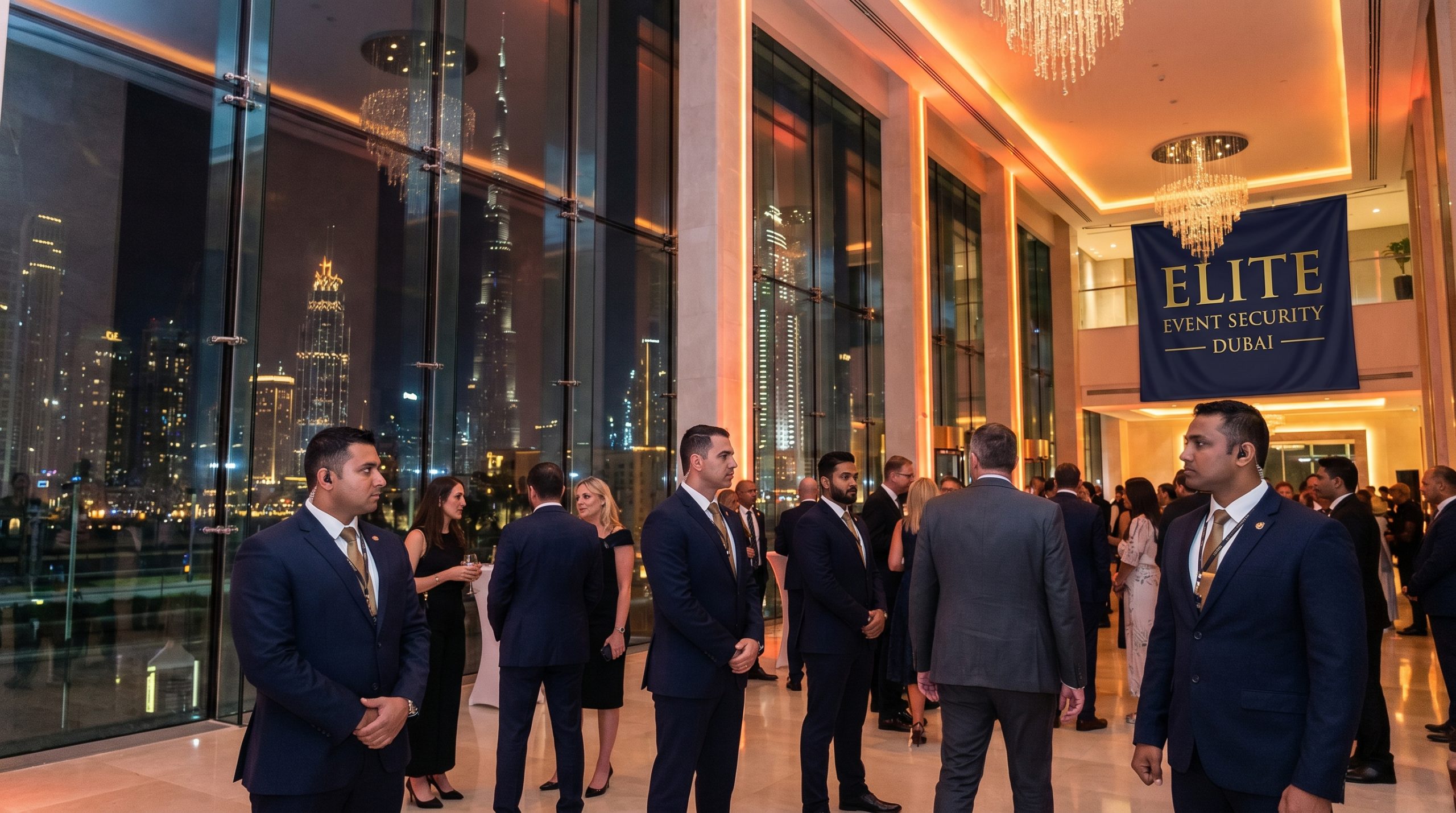
Dubai hosts more high-value events per square kilometre than almost any city on earth. Token2049 draws 20,000+ crypto attendees. GITEX brings 180,000 visitors and the region’s entire tech leadership into one building. The Dubai Airshow, the World Government Summit, Art Dubai — the list runs year-round. Every one of these events is a threat aggregator. High-net-worth principals, public executives, visiting dignitaries, and known crypto holders converge in predictable locations at advertised times. If you run event security in Dubai like you run venue logistics, you are already behind.
This post covers what competent event security in Dubai actually requires — threat assessment, access control, counter-surveillance, and the layer most planners skip entirely: what happens outside the venue.
Why Dubai Event Security Is Different
Dubai’s event security environment has specific characteristics that most imported frameworks fail to account for.
First, the attendance mix. A single crypto conference in Dubai will bring together exchange founders, fund managers with nine-figure portfolios, on-chain public addresses tied to real identities, and journalists — all in the same building, all published on a programme. This is not a hypothetical threat surface. It is an operational planning problem.
Second, the regulatory framework. Under SIRA — the Security Industry Regulatory Agency — any professional security operation in Dubai requires licensed personnel and, for large events, advance coordination with Dubai Police. Hiring unlicensed guards or bypassing SIRA registration is not only illegal under UAE law; it creates liability exposure the moment an incident occurs.
Third, the geography. Dubai’s venue infrastructure spans downtown high-rises, expo-format pavilions, private marina locations, and hotel ballrooms — each with different access control challenges, different crowd flow dynamics, and different threat vectors from the immediate perimeter.
Phase 1: Threat Assessment Before Venue Selection
Competent event security in Dubai starts before you sign the venue contract.
Profile your attendance list. Who is attending and what is their threat profile? A fintech summit attended by three publicly-known UHNWI crypto holders requires a different security posture than a B2B trade show. Map known attendees against publicly available threat intelligence — social media OSINT, corporate exposure, prior incident history.
Assess the venue’s inherent vulnerabilities. Service entrances, underground parking, CCTV dead zones, adjacent properties, and exit routing all determine whether a venue can be secured cost-effectively. Some venues in Dubai look impressive but are operationally indefensible for high-profile events.
Define the threat categories you are planning against. Event security in Dubai typically requires planning for: opportunistic theft, targeted surveillance of principals, protest or media disruption, medical emergencies, and — for crypto and finance events specifically — the physical threat to known on-chain wealth holders. These require different responses and different resource allocations.
Phase 2: Access Control Architecture
Amateur event security treats access control as badge-checking. Professional event security in Dubai treats it as a multi-layer filtering system.
Outer perimeter. The security boundary starts at the road or car park level, not the venue entrance. Traffic management, vehicle search capability, and mobile patrol between the outer perimeter and the venue are all standard in high-risk event configurations.
Inner perimeter. Credentialing, physical search, and prohibited items detection. For events with VVIP attendance, this layer should include a secondary check point isolated from general attendee flow.
Sterile zones. Any area where principals congregate — speaker prep rooms, executive lounges, backstage areas — requires its own access tier. These areas should never share access points with general attendee zones.
Staff and vendor vetting. The catering team, AV contractors, and cleaning crew are inside your sterile zone. Background checks on event support staff are non-negotiable for high-value events. Dubai’s contractor market is deep but opaque — vetting cannot be delegated to the venue.
Phase 3: Counter-Surveillance and Pre-Event Intelligence
This is the layer that separates a professional event security operation from a staffing exercise.
Hostile reconnaissance of a high-profile event typically begins 48-72 hours before the event itself. Individuals mapping attendee routes, vehicle types, and arrival windows are conducting pattern-of-life surveillance on your principals before you have positioned a single guard.
Pre-event venue survey. Walk the arrival route, vehicle drop-off points, and immediate perimeter with surveillance awareness. Are there elevated positions with sightlines to your main entrance? Parked vehicles that have not moved in 48 hours? Individuals photographing the venue from adjacent coffee shops? These are not hypotheticals — they are standard hostile reconnaissance behaviours.
Route security. For VVIP principals, the threat window is highest during transit — from hotel to venue and back. At major Dubai crypto events, we have coordinated advance team positioning at route waypoints, monitored parking structures along the route, and confirmed vehicle tracking before principal departure. The venue is the most controlled environment. The road is not.
Social media monitoring. Open-source intelligence from Instagram, X, and LinkedIn will tell a surveillance operator which known principals are in Dubai, what hotel they are staying at, and when they are scheduled to speak — days before the event. Your security team should be running the same feeds adversaries use.
Phase 4: On-Ground Operations
Static posts versus mobile patrols. Static guards on doors provide a visible deterrent but poor response capability. Effective event security in Dubai deploys static posts for credentialing and mobile patrol for threat detection and response. The ratio depends on venue size and threat level — but static-only operations are a common and exploitable gap.
Communications and command. All security personnel should operate on a single comms net with a designated incident controller. Radio discipline, code words for escalation tiers, and a clear command structure are basic requirements. At larger events, a dedicated security ops room — staffed throughout the event — is standard.
Medical and emergency integration. Dubai’s emergency response infrastructure is excellent. But at large events with multiple simultaneous crises, response times stretch. Event security in Dubai should include dedicated first-response capability on-site — at minimum, qualified first-aiders positioned at key points throughout the venue.
Principal protection details. For any named speaker or executive with a threat profile above baseline, a dedicated close protection officer shadowing them through the event is a separate cost category from general event security. Mixing a VIP detail with crowd management duties compromises both functions.
Phase 5: Post-Event Security
Most event security plans end when the last guest leaves the venue. This is the wrong cut-off.
The period immediately following a high-value Dubai event is a known risk window. Principals are moving to airports or hotels with established patterns. They may have consumed alcohol. Their security posture is relaxed. The surveillance that was running before the event has updated its pattern-of-life picture.
Departure routing. VIP principals should depart via routes and timings that have not been publicly observable. Varying vehicle types and departure windows reduces predictability.
Debrief and documentation. Any incidents, near-misses, suspicious individuals, or access violations during the event should be documented immediately — while detail is fresh. This feeds forward into threat intelligence for subsequent events and for ongoing principal protection.
SIRA Compliance for Event Security in Dubai
Under UAE law, any company providing event security services in Dubai must hold a valid SIRA licence. Specific licence categories apply to guard services, event security, and close protection. Principals and event organisers who hire security without verifying SIRA compliance expose themselves to regulatory liability, and — critically — to unvetted personnel operating under a professional cover they have not earned.
Almas Aman holds the required authorisations for close protection and advisory operations in the UAE. When we assess event security requirements for a client, we also verify that every contracted resource in the security plan is SIRA-compliant. If it is not documented, it does not go on the plan.
Applying This to Dubai’s Current Event Calendar
Dubai’s event density is increasing, not decreasing. The past six months have seen the Kraken and multiple major exchanges secure VARA licences and establish physical operations in the emirate. That trajectory brings more concentrated wealth, more public-facing executives, and more high-profile gatherings — each one a potential operation for a patient adversary.
Event security in Dubai has to be planned with the same discipline as a principal protection assignment: threat-led, layered, and extending well beyond the venue perimeter. If your current event security model starts at the door and ends when the guests go home, it is not a security programme. It is theatre.
For events in Dubai requiring a threat assessment, close protection integration, or a complete security audit, contact Almas Aman. We plan from the threat out, not from the venue in.