
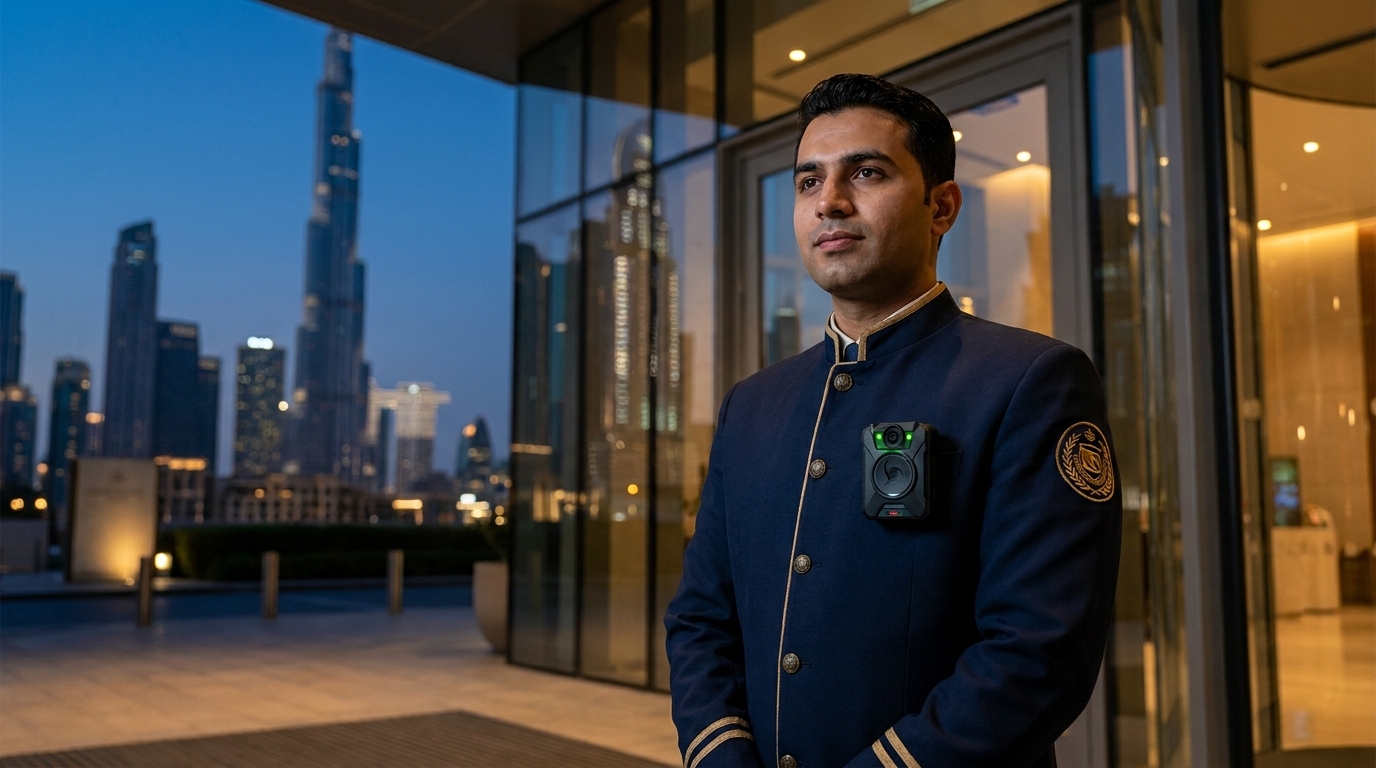
Body cameras are now the accountability baseline for Dubai security operations
If you employ security guards in Dubai, you carry responsibility for what those guards do, fail to do, and cannot prove. Body-worn cameras close that proof gap. Dubai Police are already deploying the technology across their own ranks to improve accountability, transparency and public trust, and the private-security sector is following. The message from regulators and clients is consistent: an unverifiable guard is a liability. This briefing sets out what body cameras do, what the law permits, and how to deploy them correctly across your property or estate.
Accountability is not a soft benefit. It is a documented record of conduct that protects you in disputes, insurance claims and regulatory review. When an incident occurs at your premises, the question put to you will be simple: what is your evidence? A guard wearing an operational body camera answers that question before it is asked.
Why guard accountability fails without recorded evidence
Every security contract carries the same structural weakness: the client rarely sees what the guard actually does. Paper occurrence books, shift handover sheets and verbal reports are written after the fact, by the person whose conduct is in question. They are self-reported, unverified and routinely contested. When a theft, assault, trespass or workplace dispute occurs, you are left reconstructing events from memory and hearsay.
Body-worn cameras remove that ambiguity. They capture critical evidence in real time, deter aggression before it escalates, and protect the guard as much as the employer. Frontline officers facing hostile individuals de-escalate faster when a recording is visible and announced. Complaints against guards collapse when footage contradicts the allegation. Complaints against guards are substantiated when it does not. Both outcomes serve you.
There is also a supervision dividend. Guards who know their patrol and post conduct is recorded adhere to patrol routes, post orders and SOPs with far greater discipline. The camera functions as a standing audit of your security provider’s performance, which matters if you outsource guarding and need contractual leverage at review time.
What modern body camera systems actually deliver
Not all body-worn cameras are equal, and procurement decisions should be made against operational requirements, not price. Dubai’s market now includes purpose-built law-enforcement and commercial-grade devices, showcased at events such as the World Police Summit, that set the benchmark for private deployments.
The core capabilities to specify:
- Continuous recording capacity. Devices demonstrated in the UAE, such as the Powercon PTT900, support up to 24 hours of continuous recording, covering a full double shift without a battery change. Anything less creates recording gaps exactly when you need footage.
- Live view over LTE. LTE-enabled cameras transmit live feeds to a command centre, so supervisors can observe an incident as it unfolds and direct a response in real time rather than reviewing it afterwards.
- AI edge analytics. Current-generation systems offer automatic detection of aggressive behaviour, flagging escalation before it becomes an assault. This shifts the camera from a passive recorder to an active early-warning tool.
- Ruggedisation and shift endurance. Equipment designed for law enforcement, withstanding rough conditions and lasting long shifts, will survive the realities of Dubai patrol work: heat, dust, physical confrontation and vehicle mounts.
- Activation sensors. Some units integrate weapons-activation sensors, automatically triggering capture the moment a sidearm is drawn. Relevant for armed details and cash-in-transit escorts.
- Tamper resistance. Guards must not be able to disable, delete or edit footage. Encrypted storage and controlled download to a secure evidence repository are non-negotiable.
At Almas Aman, we operate within this capability set, specifying LTE-enabled body cameras that allow command centres to view live feeds instantly and applying AI edge analytics for automatic detection of aggressive behaviour. Our services cover deployment, guard training and footage-handling procedure as a single programme, not a hardware drop.
The legal boundaries you must enforce before switching on
Technology is the easy part. Governance is what fails in practice, and it fails at the policy layer, not the device layer. Body cameras were introduced in many jurisdictions before usage policies were fully developed. Do not repeat that error on your property.
Dubai Police’s own framework provides the operating model, and your guard force should mirror it:
Officers must inform people when recording is taking place. Your guards announce recording at the start of any interaction, verbally and clearly. Covert recording by private security is a different legal matter entirely and must not be attempted.
Filming in private spaces is banned. Dubai Police rules prohibit filming in private spaces such as homes and similar private premises. For your deployment this has direct consequences: guards must not record inside private residences, changing areas, prayer rooms, toilets or leased residential units. If you run residential security, hospitality security or mixed-use developments, define the exclusion zones in writing and configure the deployment around them.
Footage is evidence, not entertainment. Establish a retention schedule, an access-control list and a disclosure procedure. Every download is logged. Every viewer is identified. Footage relevant to an incident is preserved to evidential standard; footage with no flag is purged on schedule. Handle it this way and the camera strengthens your legal position. Handle it casually and it becomes a liability in itself.
Balance enforcement with privacy. The stated aim of Dubai’s body camera initiative is to balance effective law enforcement with citizens’ privacy and peace of mind. Your programme should adopt the same posture: recording in public and common areas where the guard has a lawful security role, strict prohibition in private spaces, and transparency with everyone recorded.
Write the policy before the first camera is worn. Brief every guard on it. Test compliance in the first month. Then audit it quarterly. If you need a template structure aligned to Dubai practice, contact our team and we will set out the governance framework against your property type.
Deploying body cameras across your guarding programme
Roll out in the following sequence:
1. Risk and privacy mapping. Identify which posts carry confrontation risk: gates, reception, retail floors, concourse patrol, cash handling. Identify which areas are legally off-limits to recording. Map both before purchase.
2. Device specification. Match devices to roles. High-risk, public-facing posts get LTE live-stream units with analytics. Low-risk interior posts may not need cameras at all, and forcing them there creates privacy exposure without accountability gain.
3. Written activation policy. Define when recording starts, when it stops, the announcement requirement and the private-space prohibition. No discretion on the private-space rule.
4. Command-centre integration. Connect live feeds to your monitoring operation so supervisors see escalation as it happens and can dispatch support, not just document failure afterwards.
5. Guard training. Train officers on activation, announcement, positioning, de-escalation-on-camera technique and evidence handling. An untrained guard with a camera produces unusable footage.
6. Audit and review. Sample footage monthly. Check patrol compliance, announcement compliance and footage-handling discipline. Feed findings into performance reviews of guards and, where relevant, your security contractor.
This sequence converts the camera from a gadget into a management system. Firms that skip steps four to six typically end up with terabytes of unreviewed video and no improvement in guard conduct. To see how we structure full accountability programmes, from device selection to command-centre monitoring, review our about page and our operational approach.
The accountability dividend, stated plainly
Deployed correctly, body cameras deliver four measurable outcomes: guards who follow post orders because conduct is recorded; aggressors who de-escalate because the recording is announced; disputes that resolve quickly because footage exists; and an evidence trail that stands up to police, insurers and regulators. Dubai’s own policing direction, from body cameras to connected devices and AI-assisted systems showcased at the World Police Summit, confirms the trend is structural, not experimental. Private security operations that fail to match it will, within a short cycle, be unable to evidence their own performance. Match it now, on your terms, under a compliant policy.
Frequently asked questions
Are security guards in Dubai allowed to wear body cameras?
Yes. Commercial body cameras purpose-built for security guards are in use in the UAE, designed to deter aggression, improve business practices and capture confrontations. The requirement is governance: guards must inform people when recording is taking place, and filming in private spaces such as homes and similar private premises is banned. Deploy under a written policy that enforces both rules.
Can body camera footage be used as evidence in a dispute or insurance claim?
Yes. Real-time captured footage is precisely what makes body cameras valuable in disputes, complaints and investigations. To hold evidential weight, the footage must come from a tamper-resistant device, be stored with controlled access and a documented chain of custody, and be retained under a defined schedule. A casual clip forwarded over a messaging app will not survive scrutiny.
What should I look for when buying body cameras for my guards?
Specify continuous recording capacity sufficient for a full shift (24-hour units exist in the UAE market), LTE live streaming to a command centre, rugged construction rated for law-enforcement use, tamper-resistant encrypted storage, and ideally AI edge analytics that detects aggressive behaviour automatically. Battery life that dies mid-shift is the single most common failure point in cheap deployments.
Can my command centre watch the camera feed live?
Yes, where the camera is LTE-enabled. Live view allows supervisors to observe incidents as they unfold and direct response in real time, rather than only reviewing footage after the event. This is the difference between a recording device and an active command-and-control capability, and it is the configuration we recommend for all high-risk posts.
Where are guards prohibited from recording?
Filming is banned in private spaces such as homes and private premises, and the same principle extends to areas where occupants hold a reasonable expectation of privacy: residential units, changing rooms, toilets and prayer areas. Define these exclusion zones in writing, brief every guard, and audit compliance. Recording must always be announced, never covert.
Does a body camera programme replace supervision of my security provider?
No, it enables it. Cameras generate the audit data: patrol compliance, announcement compliance, response conduct and incident footage. Supervision is the act of reviewing that data monthly, acting on it, and using it in contractor performance reviews. Together they give you what paper occurrence books never could: verifiable, recorded proof of what happened on your property.