
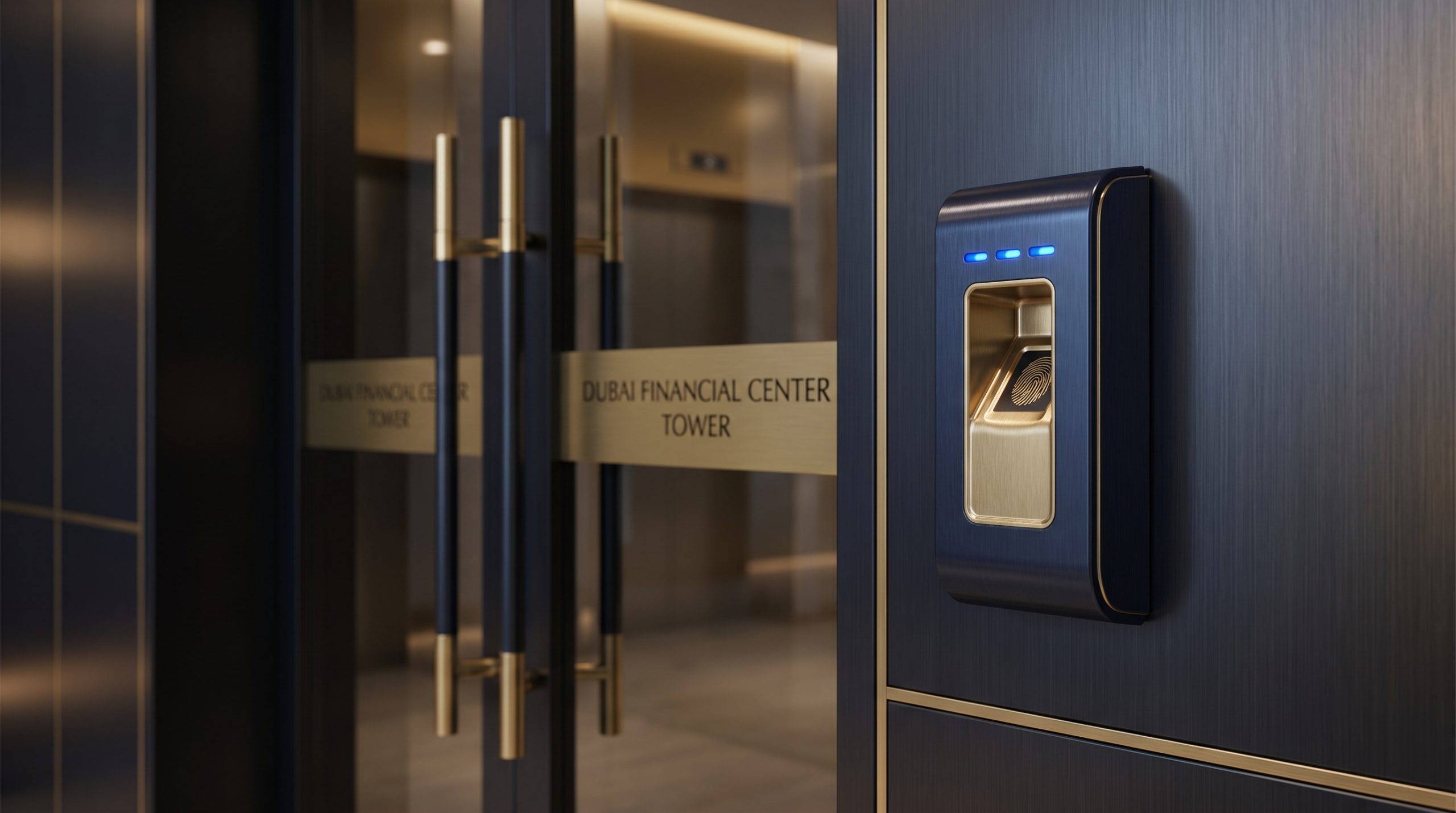
Access control isn’t an IT project. It’s a security decision — one with consequences that outlast the hardware and outlive the vendor contract. In Dubai’s high-value commercial and residential landscape, poorly configured access control has enabled insider theft, helped surveillance by hostile parties, and left organisations exposed to regulatory scrutiny from SIRA.
This guide cuts through the sales noise. Here’s what you actually need to know before specifying, procuring, or upgrading an access control system in Dubai.
What Access Control Systems Actually Do (And What They Don’t)
An access control system manages who can physically enter a space, when, and under what conditions. At its core: credentials are presented, the system validates them, and a door opens or stays shut.
What it doesn’t do — on its own — is provide security.
Access control is a deterrent and an audit trail. It slows unauthorised entry. It creates accountability. But it won’t stop a determined insider, a social engineering attack, or a vendor with a cloned credential. These limitations matter when you’re specifying a system for an executive suite, a server room, or a villa compound in Jumeirah.
The four primary credential types used in Dubai deployments:
- RFID / proximity cards — Fast, convenient, widely deployed. Lowest security. Cards are easily cloned.
- PIN keypads — Low cost, no hardware to carry. Vulnerable to shoulder surfing and code sharing.
- Biometric access control — Fingerprint, iris, or face recognition. Higher friction, significantly harder to spoof. Growing adoption in UAE enterprise.
- Mobile credentials — Smartphone-based via Bluetooth or NFC. Increasingly common in modern commercial fit-outs. Convenience-security trade-off depends on device management policies.
Most enterprise deployments in Dubai use a hybrid: biometric for high-security zones, RFID for general access, with PIN as a fallback.
SIRA Compliance and Access Control in Dubai
SIRA — the Security Industry Regulatory Agency — governs physical security systems across Dubai. Any organisation deploying access control as part of a broader security infrastructure should understand where SIRA oversight applies.
SIRA mandates apply directly to security companies operating in Dubai, and indirectly to any building security system installed or maintained by a SIRA-licensed provider. This includes access control integration with CCTV and alarm systems in commercial premises, hotels, government buildings, and critical infrastructure.
The practical implication: if your access control system is part of a monitored security package — and most enterprise deployments are — the integrating company must hold a valid SIRA license. Procuring from an unlicensed provider is a compliance failure, not just a vendor risk.
Due diligence checklist for procurement:
- Verify SIRA license of the integrating company before engagement
- Confirm the system supports audit log export in formats acceptable for regulatory review
- Ensure your contract includes data handling terms for biometric data (UAE PDPL applies)
- Require proof of installer certification for biometric systems specifically
Biometric access control in Dubai falls within the UAE Personal Data Protection Law (PDPL) framework. Biometric data is classified as sensitive personal data. Processing it requires a documented lawful basis, data minimisation, and defined retention limits. Many organisations aren’t yet compliant on this point.
Biometric Access Control Dubai: When It Makes Sense
Biometric systems command a price premium. They also offer meaningfully stronger security for the right environments. Before specifying biometric access control for a Dubai deployment, assess whether the risk profile justifies the cost and complexity.
Environments where biometric access control earns its premium:
Data centres and server rooms. Card cloning is a documented attack vector in corporate espionage. Biometric-only entry for network infrastructure is a sensible baseline in any organisation handling sensitive data.
Executive floors and C-suite access. Principals with elevated threat profiles shouldn’t rely on credentials that can be lost, stolen, or cloned. Biometric + PIN multi-factor for private offices is standard practice in well-protected organisations.
High-value residential compounds. Villa communities and private residences in Palm Jumeirah, Emirates Hills, and similar areas increasingly deploy biometric access at perimeter and vehicle gates. Domestic staff management is a specific use case: time-bound biometric credentials prevent credential sharing and provide an accurate access log.
Warehouses and logistics. High shrinkage environments benefit from biometric control over stock rooms, bonded areas, and loading bays where RFID-based card sharing is endemic.
Environments where biometric is overkill:
General office floors, car parks, and common areas in commercial buildings rarely justify biometric over a well-managed RFID system with proper card lifecycle management.
Access Control System Dubai: Deployment Pitfalls That Repeat
The same failures appear across Dubai deployments. These aren’t theory — they’re patterns from real-world security audits.
Credential sprawl. Organisations accumulate access rights over years without systematic deprovisioning. Contractors, former staff, and third-party vendors retain active credentials long after their engagement ends. In one logistics hub audit, 23% of active access credentials belonged to individuals no longer associated with the organisation.
Remediation: monthly credential audits tied to HR offboarding. Non-negotiable.
Tailgating at controlled doors. No access control system prevents tailgating if the physical environment enables it. A single door with no mantrapping, no visual deterrent, and no guard presence is a gap regardless of the credential technology deployed.
Remediation: anti-passback configuration in the access control software, combined with physical turnstile or airlock at high-security zones.
No tested incident response for door failures. Controllers fail. Power cuts happen. Many Dubai sites have never tested what actually occurs when their access control system goes offline. The answer, often, is that all doors fail open — which is precisely the wrong default for a secure perimeter.
Remediation: verify fail-safe vs. fail-secure settings for every door in the specification. Life-safety exits must fail open; secure access points should fail secure. Document the decision for each door.
Integration gaps between access control and CCTV. Modern systems can cross-reference an access event with CCTV footage in real time. Most deployments don’t have this configured. The result is an audit trail that’s technically complete but operationally useless in incident response.
Remediation: insist on integrated video event correlation in the system specification. This isn’t a luxury add-on — it’s the difference between a system that investigates incidents and one that merely records them.
Selecting an Access Control System Company in Dubai
The Dubai market is saturated with access control vendors. Quality varies significantly. The following criteria matter more than brand recognition.
Post-installation support. The access control system you procure will need firmware updates, credential management, and incident response for the life of the installation. Evaluate the vendor’s support capability, not the sales team.
IP-based vs. legacy architecture. Legacy RS-485 panel-based systems are still being sold and installed in Dubai. For new installations, IP-based systems with encrypted communications are the correct specification. They support remote management, scale more easily, and integrate cleanly with modern security operations centres.
Manufacturer independence. Proprietary systems from small local integrators create vendor lock-in. Specify systems on open-standard platforms (OSDP, Wiegand-compatible, API-accessible) where possible.
References from comparable deployments. Ask for references specifically from similar environments — not a retail fit-out reference when you’re specifying a private residence.
Almas Aman has no commercial stake in access control hardware or integration contracts. When we assess a site’s physical security posture, our recommendations are vendor-agnostic and based solely on the threat model and operational requirements of the client.
What a Professional Access Control Review Covers
A security consultant’s access control review isn’t the same as a vendor site survey. The vendor wants to sell you a system. A security review is objective.
A proper review covers:
- Threat modelling — Who are the realistic adversaries? Opportunistic thieves? Disgruntled insiders? Nation-state actors targeting a principal? The threat model determines the appropriate credential type, layering, and monitoring posture.
- Perimeter mapping — Every physical entry point catalogued, including maintenance access, fire exits, rooftop access, and utility rooms. These are consistently exploited in penetration testing.
- Existing system audit — If a system is in place: credential audit, firmware version check, integration assessment, and log review.
- Operational procedures review — Technology without procedure fails. Who manages credential issuance? What’s the offboarding process? How are security events reviewed?
- Regulatory gap analysis — SIRA compliance, UAE PDPL alignment for biometric data, and any sector-specific requirements (DIFC, ADGM, healthcare, government).
Taking the Next Step
Access control decisions made without a clear security brief tend to produce expensive systems that are technically sound but operationally compromised. The gaps are rarely in the hardware — they’re in the integration, the procedures, and the ongoing governance.
Almas Aman provides security risk assessments and advisory services for organisations and private clients in Dubai and across the UAE. Our access control advisory is one component of a broader physical security review — conducted without hardware sales interest and guided entirely by the client’s risk profile.
If you’re planning an access control upgrade, specifying a new installation, or concerned about the security posture of an existing system, contact Almas Aman to arrange a consultation.