
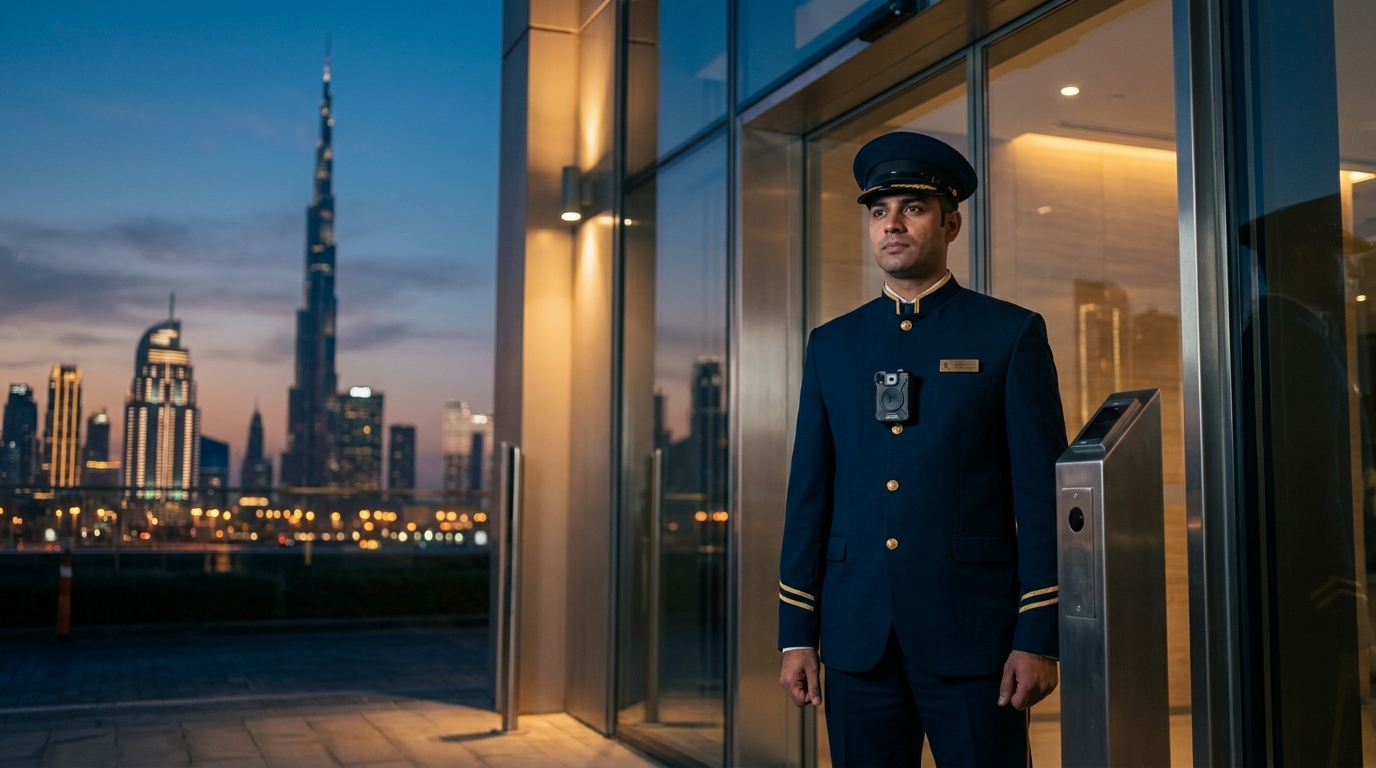
Dubai’s body camera rules changed in 2026. Here is what applies to your security operation.
On 2 June 2026, Sheikh Hamdan bin Mohammed bin Rashid Al Maktoum issued Executive Council Resolution No. 13 of 2026, the most detailed regulatory framework Dubai has ever published on the use of cameras in documenting violations and executing judicial judgments and decisions. If you operate a private security company in Dubai, or you contract one to protect your premises, this resolution sets boundaries you need to understand before you deploy body cameras on your guards.
The resolution is not a minor procedural update. It establishes who may use cameras, when recording must be disclosed, where filming is prohibited, and how recordings may be handled. Getting this wrong exposes your firm to regulatory action and privacy liability under the UAE’s data protection regime. This briefing sets out the facts, separates what is mandated from what is permitted, and identifies the decisions you now face.
What Executive Council Resolution No. 13 of 2026 actually requires
The resolution governs the use of cameras by enforcement officers in Dubai. Its core provisions are direct:
1. Cameras must be used only by enforcement officers belonging to the categories to which the resolution applies.
2. Cameras must be used for the purposes the resolution defines, namely documenting violations and the execution of judicial judgments and decisions.
3. Personal device use is forbidden. Officers may not copy, store, or transfer recordings to personal devices or unauthorised systems.
4. Any personal or unlawful use of recordings is prohibited.
5. Enforcement officers must inform people when recording is taking place.
6. Filming is banned in private spaces such as homes and similar premises.
7. Training is mandatory. Government entities must provide structured training for personnel who use cameras, and the resolution outlines legal and ethical duties around privacy protection.
The stated objective is transparency and integrity in enforcement actions. Dubai’s Executive Council framed the rules as a mechanism to promote accountability in how violations are documented and how judicial decisions are carried out.
Read those provisions carefully and one point stands out immediately: the resolution is written for enforcement officers, not for ordinary security guards. That distinction matters, and the next section addresses it head-on.
Are private security guards required to wear body cameras in Dubai?
No UAE regulator requires an ordinary security guard to wear a camera. As of the resolution’s issuance, there is no general legal mandate compelling security guards to be equipped with body-worn cameras. The resolution does not impose a blanket camera requirement on private security personnel.
However, the resolution does apply to private security companies operating in Dubai in a meaningful way. First, if your personnel act in any capacity that falls within the enforcement categories the resolution covers, the camera rules attach to that activity. Second, the resolution establishes the compliance standard Dubai’s regulators now expect for any camera use in enforcement-adjacent contexts: disclosure before recording, prohibition on filming in private spaces, no personal device handling, and structured training.
Third, and this is the operational reality, if you choose to deploy body cameras on your guards voluntarily, you are stepping into a regulated space. The resolution’s privacy protections, its ban on filming in private spaces, and its handling restrictions represent the benchmark against which your camera programme will be judged if a complaint arises. Voluntary deployment does not mean unregulated deployment.
The prudent position is this: treat the resolution’s requirements as your compliance floor, even where they are not directly binding on your guards. A security company that records without disclosure, films inside private spaces, or allows officers to move footage to personal devices will face questions under both this framework and the UAE’s broader data protection law.
The privacy law dimension: PDPL obligations sit behind every recording
Body camera footage is personal data. Federal Decree-Law No. 45 of 2021, the UAE Personal Data Protection Law, has been in force since 2 January 2022, and it applies to the processing of personal data including video recordings of identifiable individuals. Be careful with confident claims you may read online that the PDPL’s Executive Regulations have been issued and that full enforcement is switched on. As of September 2026, authoritative legal tracking indicates the Executive Regulations have still not been formally published in the Official Gazette as a discrete instrument, despite being expected for some time.
That gap does not suspend your obligations. The PDPL itself is in force, and sector-specific rules, including SIRA’s licensing regime for security providers in Dubai, already impose binding operational requirements. For a security company running a camera programme, the practical obligations are:
- Disclose recording where individuals would reasonably expect privacy, consistent with the resolution’s disclosure principle.
- Do not film in private spaces such as homes and similar premises.
- Restrict access to footage to authorised personnel on authorised systems only.
- Prohibit any transfer of recordings to personal devices.
- Define retention periods and deletion schedules before deployment, not after an incident.
- Train every officer who operates a camera on both the technical use and the legal and ethical limits.
If your current security provider cannot show you written policies covering each of those six points, that is a gap you should close. At Almas Aman, we treat camera handling, disclosure, and footage custody as controlled procedures with documented training, because that is what the regulatory direction of travel in Dubai demands. You can review our full capability set on our services page, and our licensing and operational standards are detailed on the about page.
The technology and training picture beyond the resolution
Dubai’s policing and security establishment is moving decisively toward camera-enabled accountability. The World Police Summit in Dubai showcased body-worn cameras alongside AI-driven policing tools, automated incident response systems, and investigation-support technology. The direction is unmistakable: recording technology, AI-assisted review, and structured accountability are becoming the norm in how enforcement and security incidents are documented in the emirate.
For private security operators, this creates a planning question. Even without a mandate, body cameras deliver evidentiary value: they resolve disputes over guard conduct, they deter aggression toward officers, and they provide verifiable records for insurers and police. But the same technology creates liability when it is deployed without disclosure rules, storage controls, and training.
The resolution’s training requirement for government entities is instructive. Dubai’s regulators have signalled that camera use without structured training is unacceptable in the public sector. A private security company that deploys cameras with no documented training programme is out of step with that standard, and that inconsistency will be noticed if footage from your guards is ever submitted in a dispute or investigation.
Your decision framework for 2026
If you are a facilities manager or business owner contracting security in Dubai, put three questions to your provider now:
1. Do your guards wear cameras, and under what written policy?
2. Where is footage stored, who can access it, and how quickly is it deleted?
3. Show me your training records for camera use and privacy obligations.
If your provider answers with generalities, treat that as a finding. If you operate your own security team, build the policy before the hardware purchase: disclosure protocols, private-space prohibitions, device handling rules, retention schedules, and training records. The resolution gives you the template. Use it.
Where the requirements are unclear for your specific operation, do not guess. contact our team and we will assess your site against the current SIRA framework and the 2026 resolution before you commit to a camera programme.
Frequently asked questions
Are security guards in Dubai legally required to wear body cameras in 2026?
No. No UAE regulator requires an ordinary security guard to wear a camera. Executive Council Resolution No. 13 of 2026 governs camera use by enforcement officers and does not impose a general camera mandate on private security guards, though it applies to private security companies operating in Dubai in the ways described above.
Does Executive Council Resolution No. 13 of 2026 apply to private security companies?
Yes, in a qualified sense. The resolution’s camera rules apply to enforcement officer categories, but private security companies operating in Dubai must recognise its standards on disclosure, private-space filming bans, personal device prohibitions, and training, because those standards define the compliance benchmark for any camera use in enforcement-adjacent activity.
Can a security guard record on a personal phone instead of a body camera?
No. The resolution prohibits personal device use for recordings. Officers may not copy, store, or transfer recordings to personal devices or unauthorised systems, and any personal or unlawful use of recordings is prohibited. A guard filming on a personal phone creates immediate legal exposure for the security company.
Must people be told when a security officer is recording them?
Under the resolution, enforcement officers must inform people when recording is taking place. As a compliance standard, any private security camera programme in Dubai should adopt the same disclosure discipline, particularly in areas where individuals have a reasonable expectation of privacy.
Is the UAE data protection law enforceable against security companies right now?
Yes. Federal Decree-Law No. 45 of 2021 has been in force since 2 January 2022. The Executive Regulations remain pending as of September 2026 by authoritative accounts, but that does not suspend the law, and sector rules such as SIRA’s licensing regime already impose binding obligations on security providers.
Where is filming prohibited under the new rules?
Filming is banned in private spaces such as homes and places of a comparable private character. Security operations must respect this prohibition absolutely, and camera policies must define which areas of a client site fall within it.