
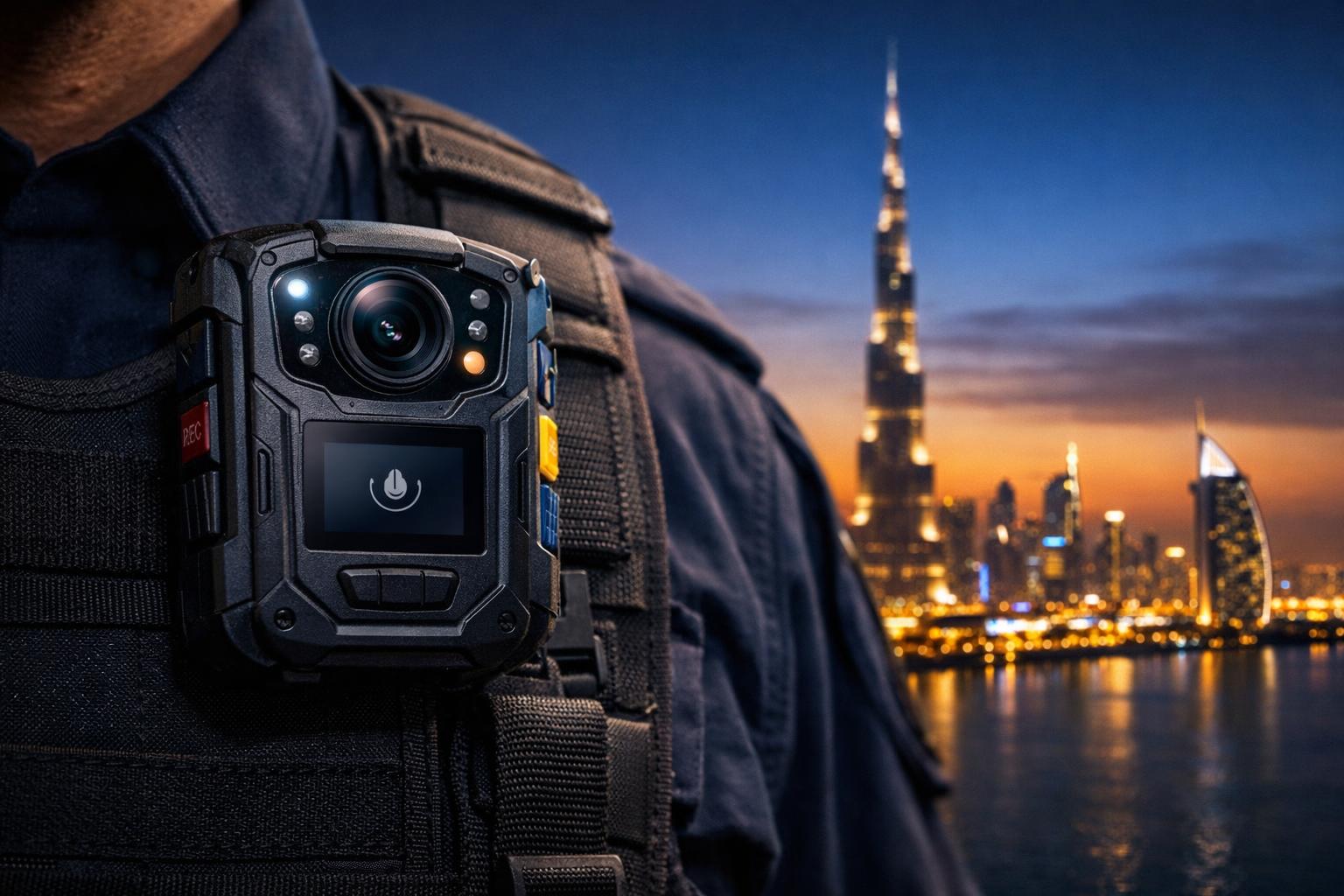
On June 2, 2026, Sheikh Hamdan bin Mohammed bin Rashid Al Maktoum issued Executive Council Resolution No. 13 of 2026 — a regulatory framework governing the use of cameras by enforcement officers in Dubai. This is not a minor procedural update. It is the most comprehensive set of rules Dubai has ever published on video recording during enforcement actions, and it carries direct implications for private security companies operating in the emirate.
If your firm provides surveillance, body-worn cameras, security monitoring, or contracted enforcement services in Dubai, this resolution changes how you operate. Here is what it says, what it means, and what you need to do about it.
The Core Requirements of Resolution No. 13 of 2026
The resolution applies to all enforcement officers — government employees and private contractors alike — who use cameras to document violations and execute judicial judgments.
Recording is permitted, but controlled. Officers may only use cameras for official duties under their authority’s guidelines. Recording in private residences, places of worship, and changing rooms is explicitly prohibited. Individuals must be informed when recording is taking place.
Storage must be encrypted and audited. All recordings must be stored electronically by the relevant government entity. The Dubai Electronic Security Centre’s information security and business continuity policies govern retention and handling. Government entities must maintain a database of authorised users and access levels.
Personal device use is forbidden. Officers may not copy, store, or transfer recordings to personal devices or unauthorised systems. Any personal or unlawful use of recordings is prohibited.
Training is mandatory. Government entities must provide structured training before granting judicial enforcement powers. This covers the resolution’s application, documentation procedures, secure handling, and the legal and ethical duties around privacy protection.
Private contractors are explicitly covered. The resolution applies to private companies contracted by government entities or assigned statutory functions. If your security firm provides officers who wear body cameras or operate surveillance systems in an enforcement context, you fall under this regulation.
What This Means for Private Security Companies in Dubai
This is the clause that matters most to firms like Almas Aman and every other security provider operating under SIRA regulation.
If your security personnel wear body cameras while performing contracted enforcement duties — property access control, facility monitoring, eviction support, regulatory compliance checks — you must ensure:
- All recording equipment and storage systems comply with Dubai Electronic Security Centre standards
- Your personnel receive documented training on the resolution before they begin enforcement work
- You maintain a logged, auditable system of authorised users and access permissions
- Recordings are stored on government-managed or approved systems, not local devices
- No recordings leave the approved chain of custody without written authorisation
The resolution does not specify separate penalties for non-compliance by contractors, but the Dubai Electronic Security Centre’s data protection regulations carry their own enforcement teeth. Breaches of data security protocols — especially unauthorised access to or distribution of recordings — can lead to licence suspension, fines, and criminal liability under Dubai’s broader data protection framework.
How This Connects to SIRA Compliance
This is not an isolated regulation. It builds on the Security Industry Regulatory Agency’s existing framework for security companies in Dubai.
SIRA already requires licensed security firms to maintain certain standards around equipment, training, and operational conduct. Resolution No. 13 adds a specific data security layer that SIRA-licensed companies must now incorporate into their compliance programmes.
The connection points are direct:
- SIRA training centre courses should now include module content on encrypted recording storage and authorised access protocols
- SIRA certification audits should verify that body-worn camera programmes meet Dubai Electronic Security Centre standards
- SIRA portal submissions for operational approvals should reference compliance with this resolution where camera use is involved
We recommend that security firms review their existing SIRA compliance documentation and add a data governance addendum covering Resolution No. 13 of 2026 before their next audit cycle.
What the Dubai Electronic Security Centre Requires
The resolution explicitly defers to DESC for information security and business continuity standards. While the full DESC technical specification is not published alongside the resolution, the requirements are clear:
- Encrypted storage — all recordings must use encryption at rest and in transit
- Access control — auditable, role-based access with individual user accountability
- Data retention — recordings retained in line with DESC retention schedules
- Incident reporting — any breach of recording data must be reported through DESC channels
- Business continuity — recording systems must be covered by DESC-aligned disaster recovery plans
Security companies that do not already have a DESC-compliant data management framework should prioritise building one. The resolution suggests that enforcement begins from the date of publication in the Official Gazette, and compliance expectations will take effect shortly after.
Practical Steps for Security Firms
Step one: audit your camera equipment and data storage. Inventory every body camera, fixed surveillance unit, and mobile recording device used in enforcement contexts. Map where data flows — from capture to storage to authorised access.
Step two: update your training programme. Your SIRA-approved training should now include resolution-specific modules. Officers need to know where they can and cannot record, how to handle recordings, and what constitutes unauthorised access.
Step three: implement DESC-aligned data security. If you do not have encrypted storage, role-based access control, and auditable logging for your recording systems, you need to contract a provider who does.
Step four: document compliance for audit. Maintain records of training completion, equipment certification, storage architecture, access logs, and incident reports. These will be requested in any SIRA compliance audit going forward.
Step five: review your contracts. If you provide enforcement officers to government entities or property management firms, your service agreements should explicitly reference compliance with Resolution No. 13 of 2026. This protects both you and your client.
Why This Matters for Dubai’s Security Industry
Dubai is tightening its regulatory environment across the board. Executive Council Resolution No. 13 of 2026 signals that the government expects private security companies to operate at the same data security standard as government enforcement agencies.
This is part of a broader trend in the UAE toward regulated surveillance — the Hassantuk system for fire safety monitoring, the expansion of smart city CCTV networks, and now body-worn camera governance. Security companies that invest in compliant, transparent, and auditable operations now will have a significant advantage when SIRA and DESC begin enforcement.
The window for voluntary compliance will not remain open indefinitely.
Contact Almas Aman for Compliance Support
Navigating Dubai’s regulatory landscape requires expertise that most in-house security teams do not have. At Almas Aman, we advise security firms and private organisations on SIRA compliance, DESC data security standards, and operational security frameworks.
If your company needs to audit its camera systems, update its training programmes, or align with Resolution No. 13 of 2026 before the next audit cycle, contact our advisory team. We operate at the intersection of security operations and regulatory compliance — and we know how Dubai’s regulators think.
Contact Almas Aman today for a compliance readiness assessment tailored to your firm’s operational profile.