Dubai has changed the rules. Not quietly, not gradually — the Security Industry Regulatory Agency has spent the last 18 months overhauling the licensing framework that governs every armed guard, close protection team, and event security provider operating in the emirate. If you hire security in Dubai, or you work in the industry, the regulatory picture looks different today than it did in 2024.
This is a briefing on where things stand.
What SIRA Actually Governs
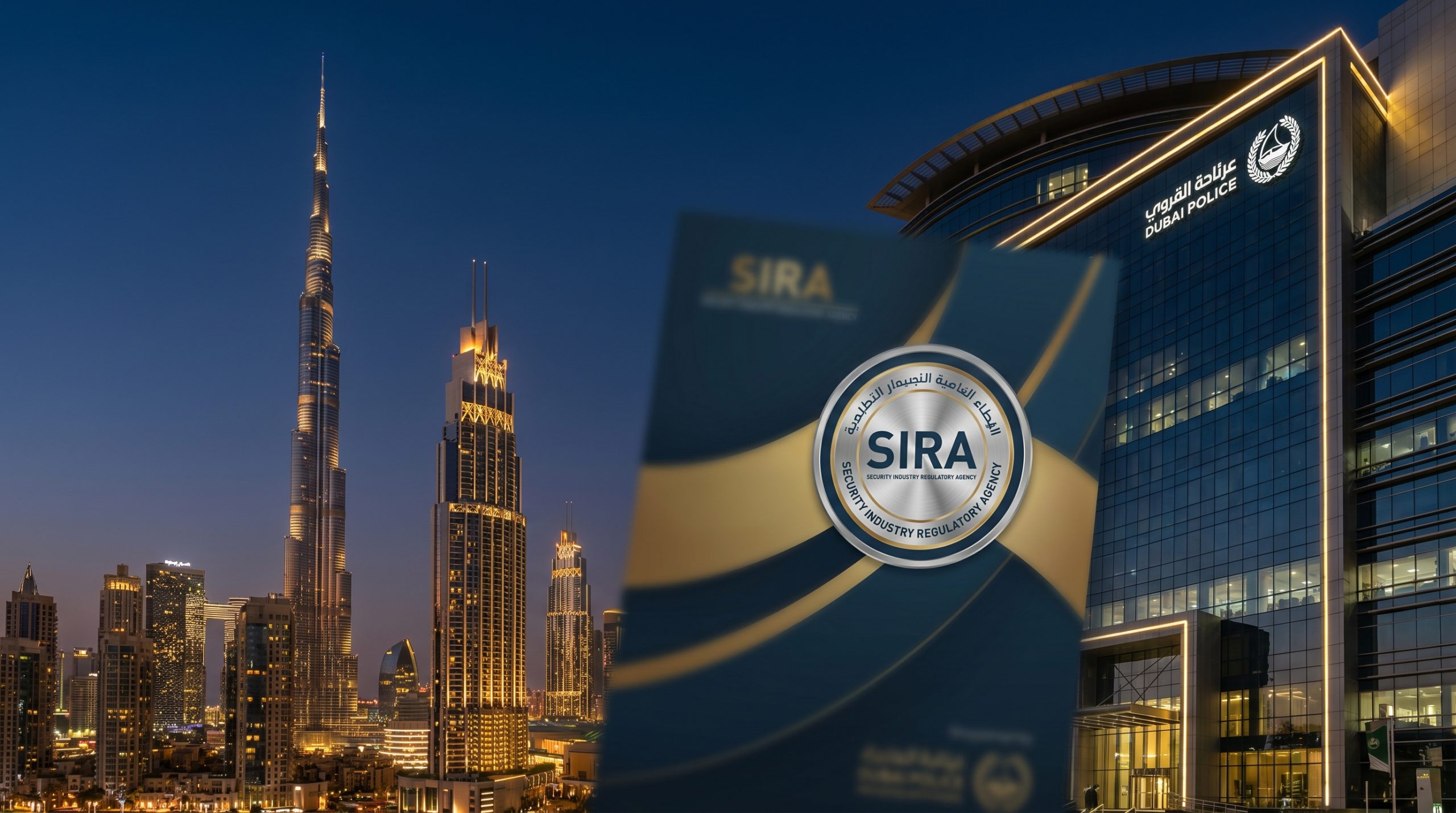
The Security Industry Regulatory Agency sits under the Dubai Police General Headquarters. Its mandate is broad: SIRA Dubai licenses security companies, certifies individual security professionals, regulates training centres, and enforces compliance across the private security sector.
That covers more ground than most clients realise. SIRA approval is required for:
- Security companies operating in Dubai (company licence)
- Individual security officers working in the emirate (personal licence)
- Training centres delivering SIRA-approved security education
- Specific security services including close protection, event security, and CCTV monitoring
If you are hiring a personal bodyguard in Dubai, a close protection team for a roadshow, or event security for a private function — the individuals and the company providing them should hold valid SIRA certification. Ask for it. If they cannot produce it, walk away.
The 2025-2026 Regulatory Shift
SIRA’s enforcement posture hardened in 2025. Three changes are directly relevant to buyers of security services.
Stricter company re-registration requirements. From Q3 2025, security companies in Dubai must demonstrate active compliance to renew their operating licences. This includes submitting audit records showing that their deployed personnel hold current individual certifications. Dormant or administratively maintained licences are being declined on renewal.
New training standards for close protection. The PSBD (Private Security Business Department) examination now includes an expanded module on surveillance detection and counter-surveillance basics. This reflects pressure from high-net-worth client segments who increasingly demand that close protection officers understand pre-attack surveillance, not just physical intervention.
Digital integration with Dubai Police systems. SIRA certification records are now linked to the Dubai Police unified operations platform. Officers operating without a current SIRA licence generate automatic flags when their credentials are checked via the police portal. This makes enforcement faster and spot checks more consequential for non-compliant providers.
Why This Matters to HNWI Clients Specifically
There is a category of buyer — typically high-net-worth individuals arriving in Dubai for business or relocation, family offices, or crypto-adjacent executives — who engages security services on an informal basis. A referral from a fixer. A “team” assembled quickly for an event. No documentation checked, no licence verified.
This approach carries compounding risk in 2026.
First, the liability exposure. If an unlicensed security officer is involved in an incident — a use-of-force situation, an injury, a claim of negligence — the client who engaged that provider can face regulatory scrutiny alongside the company. Dubai’s legal framework does not treat “I didn’t know” as a complete defence when due diligence was available and not exercised.
Second, the operational risk. The regulatory changes have created a two-tier market. Compliant, well-resourced security companies have invested in re-certification, upgraded training, and system integration. Informal providers have not. The quality gap between licensed and unlicensed teams in Dubai is widening, not closing.
Third, the intelligence value. SIRA-licensed close protection officers with the new PSBD curriculum bring a different level of situational awareness than unvetted guards. For principals operating in environments with elevated threat profiles — crypto executives, public figures, visiting dignitaries — that difference is operationally significant.
What Is Changing for International Security Teams
If you are an HNWI or corporate client who travels with an existing international close protection team, the SIRA framework has specific implications.
International security professionals working in Dubai require SIRA approval even if they hold licences from other jurisdictions — including UK SIA, US state licences, or European equivalents. There is no automatic reciprocity. A team that is fully compliant in London needs SIRA authorisation to legally operate in Dubai.
The process is not impossible. SIRA has an application pathway for foreign-trained operators, and experienced providers know how to navigate it. But it takes time — typically four to eight weeks for individual certifications — and it requires documentation that ad hoc teams rarely have assembled in advance.
This is one of the most common gaps we see with inbound HNWI clients. The team they use everywhere else is not cleared for Dubai. Replacing or supplementing that team on short notice, without compromising protective continuity, requires planning that starts before departure.
The SIRA Portal and Verification
SIRA Dubai operates a public-facing portal at sira.gov.ae. It allows clients and contracting parties to verify:
- Company licences (active, suspended, or expired)
- Individual security officer certifications
- Approved training centres in Dubai
Before engaging any security company in Dubai, verify their licence through the portal directly. Do not rely on copies of certificates provided by the company — certificates can be altered, held beyond their expiry date, or represent licences that have since been suspended. The SIRA portal is the authoritative source.
This takes two minutes. It is not bureaucracy. It is basic due diligence.
SIRA’s Enforcement Trajectory in 2026
The regulatory enforcement trend in Dubai is toward tighter compliance, not looser. The reasons are structural.
Dubai’s position as a hub for ultra-high-net-worth individuals, crypto wealth, and sovereign family offices creates a market that attracts both legitimate, well-resourced security providers and informal operators seeking to capitalise on demand. SIRA’s expanded enforcement posture is a direct response to the latter.
Expect the following in the 12 months ahead:
- More spot-check enforcement at high-profile events and venues
- Expanded digital verification infrastructure making non-compliance harder to conceal
- Increased pressure on hotels and event venues to verify the compliance status of third-party security providers operating on their premises
- Continued elevation of PSBD training standards, particularly in surveillance detection and advanced threat scenarios
For buyers of security services, this trajectory is positive. It is pushing the market toward professionalisation. The providers who will struggle are those who have been operating on the margins of compliance. The providers who will benefit — and whose clients will benefit — are those who have been building to a higher standard all along.
Almas Aman and SIRA Compliance
Every Almas Aman close protection officer operating in Dubai holds a current SIRA certification. Our company licence is maintained in active compliance. When we deploy a team, clients can verify our credentials directly through the SIRA portal before operations begin.
We do not operate informal teams. We do not offer workarounds for regulatory requirements. If a client asks us to deploy unlicensed personnel — for speed, for cost, for convenience — the answer is no.
This is not a commercial differentiator. It is a minimum standard. The fact that it differentiates us in the Dubai market says something about the market, not about us.
If you are assessing security providers in Dubai, start with the SIRA portal check. If a provider cannot pass it, move on. If you need a provider who can, contact Almas Aman directly.