
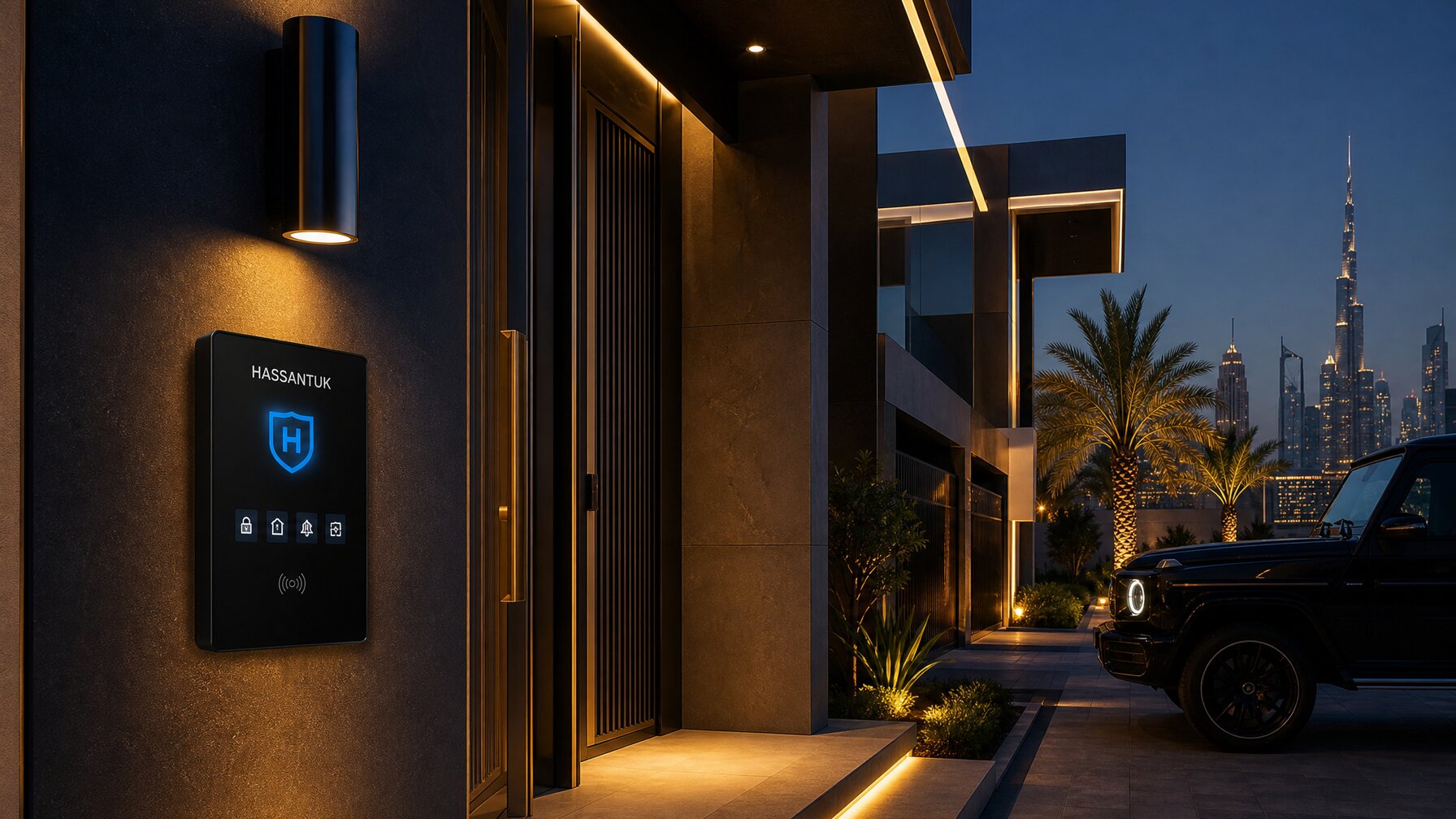
Dubai installs a security system in every new villa whether you ask for it or not. The system is called Hassantuk — operated by Dubai Police in partnership with Etisalat — and it connects residential properties directly to the Command and Control Centre. If an alarm triggers and you do not respond within a set window, a patrol is dispatched. That is the reality of living in a city that treats property security as infrastructure, not an optional extra.
This article covers what Hassantuk is, how registration works, what the system actually does, and what property owners in Dubai need to know about compliance and costs.
What Is Hassantuk?
Hassantuk (حصنتك — Arabic for “your fortress”) is Dubai Police’s residential alarm monitoring and response system. It was launched in 2019 under the directive of Lt. General Abdullah Khalifa Al Marri, Commander-in-Chief of Dubai Police, as a mandatory security requirement for all new residential villas in Dubai.
Key facts:
- Mandatory for all new villas constructed from 2019 onward
- Operates over Etisalat’s eLife fibre-optic network
- Connected to Dubai Police’s central Command and Control Centre
- Includes intrusion detection sensors, control panel, and panic buttons
- Delivers a police response guarantee of eight minutes in most areas
The system was expanded in 2023 to cover older villas during ownership transfers. If you are buying or selling a property in Dubai, Hassantuk compliance is now part of the transaction process.
How Hassantuk Works — The Technical Side
A standard Hassantuk installation includes:
- Central control panel — The brain of the system, connected to Etisalat’s fibre network
- Door and window sensors — Magnetic contact sensors on all entry points
- PIR motion detectors — Passive infrared sensors in key zones inside the villa
- Siren and strobe — External audible and visual alarm
- Two panic buttons — Wired to the control panel
- Backup battery — Eight hours of standby power
When a sensor is triggered while the system is armed, the control panel sends a signal to Dubai Police’s monitoring centre. The centre attempts to contact the property owner via phone. If there is no response within 60 seconds, Dubai Police dispatches a patrol vehicle.
The patrol dispatch is not an automatic response — the system defaults to visual verification via external CCTV where available, and operators can assess the severity before sending units.
Hassantuk Login and the Smart App
Property owners interact with Hassantuk through the Dubai Police Smart App:
- Download the Dubai Police Smart App from the App Store or Google Play
- Register using your UAE Pass or Emirates ID
- Navigate to the Hassantuk section
- Arm or disarm the system remotely
- View alarm history and sensor status
- Manage emergency contacts
The Hassantuk login portal (accessible via web at hassantuk.ae) provides the same functionality for desktop users.
The key detail: you cannot arm or disarm the system without the app or web portal once the patrol threshold is configured. If you leave the villa without setting the system, or if you fail to respond to a monitoring centre call when you are inside, a patrol will be dispatched. False alarms result in fines.
Hassantuk Registration Process
If you own a qualifying villa, registration follows these steps:
- Verify eligibility — Check whether your property falls under the mandatory category. Newer villa communities like Dubai Hills, Mohammed Bin Rashid City, Al Furjan, and Damac Hills are included. Older standalone villas may require voluntary registration.
- Contact an approved installer — Hassantuk installation must be performed by Etisalat-approved security companies. The system cannot be self-installed.
- Schedule installation — Installation takes approximately two to three hours for a standard villa.
- Activate through the Dubai Police Smart App — After installation, activate your account via the app. You will need your Emirates ID, tenancy contract or title deed, and your eLife account number.
- Set monitoring preferences — Choose your emergency contacts and set the call-waiting duration before patrol dispatch.
The total cost — including hardware, installation, and two years of monitoring — ranges from approximately AED 2,500 to AED 4,500 depending on the villa size and installer.
Compliance Requirements for Property Owners
Hassantuk compliance has real-world implications for property transactions:
- New villas: Developers are required to install Hassantuk before handing over units. Check that yours is activated.
- Property transfers: When selling a villa, the seller must provide proof of Hassantuk compliance. Without it, the Dubai Land Department can delay the transfer.
- Existing villas: If you own an older villa built before 2019, Hassantuk is currently voluntary unless triggered by a property transfer.
- Annual fees: After the initial two-year period, ongoing monitoring fees are approximately AED 500 per year for standard residential properties.
False Alarm Penalties
Dubai Police does not treat false alarms lightly. The penalty structure is designed to encourage proper system management:
- First false alarm: Warning
- Second false alarm: AED 500 fine
- Each subsequent false alarm: AED 1,000 fine
The most common cause of false alarms is arming the system while someone is still inside the villa. The second most common cause is pets triggering motion sensors — check that your installer zones the property correctly for pet movement.
How Hassantuk Fits Into a Broader Security Strategy
Hassantuk is a perimeter alarm system — it detects intrusion and calls for a response. It is not a security system in the broader sense of preventing an incident from occurring. Property owners should understand the distinction.
A complete residential security posture in Dubai includes:
- Physical deterrence: Good lighting, secure perimeter walls, access control at the gate
- CCTV coverage: Internal and external cameras with cloud backup — your own system, not the police’s
- Vulnerability assessment: Understanding which entrances, windows, and blind spots are the weak points in your villa
- Operational protocols: Who has keys, who has the alarm code, and what happens if you travel
- Executive protection overlay: For high-threat individuals, Hassantuk is a base layer — not a replacement for a dedicated security team
At Almas Aman, we routinely assess properties where Hassantuk is installed but the owner has no idea how it works or whether it is armed. That gap is the difference between a monitored property and a false sense of security.
The Bottom Line
Hassantuk is mandatory for most Dubai villa owners. It provides a direct link to Dubai Police and guarantees a response in the event of a verified intrusion. But it is a single layer in a broader security framework.
If you own a villa in Dubai and have not checked your Hassantuk status in the past six months, log into the Dubai Police Smart App today and confirm that the system is active, your emergency contacts are current, and you understand the arming procedures. The alternative is a fine — or a patrol showing up at your property unannounced.
Need a professional assessment of your residential security posture in Dubai? Contact Almas Aman for a confidential consultation.