
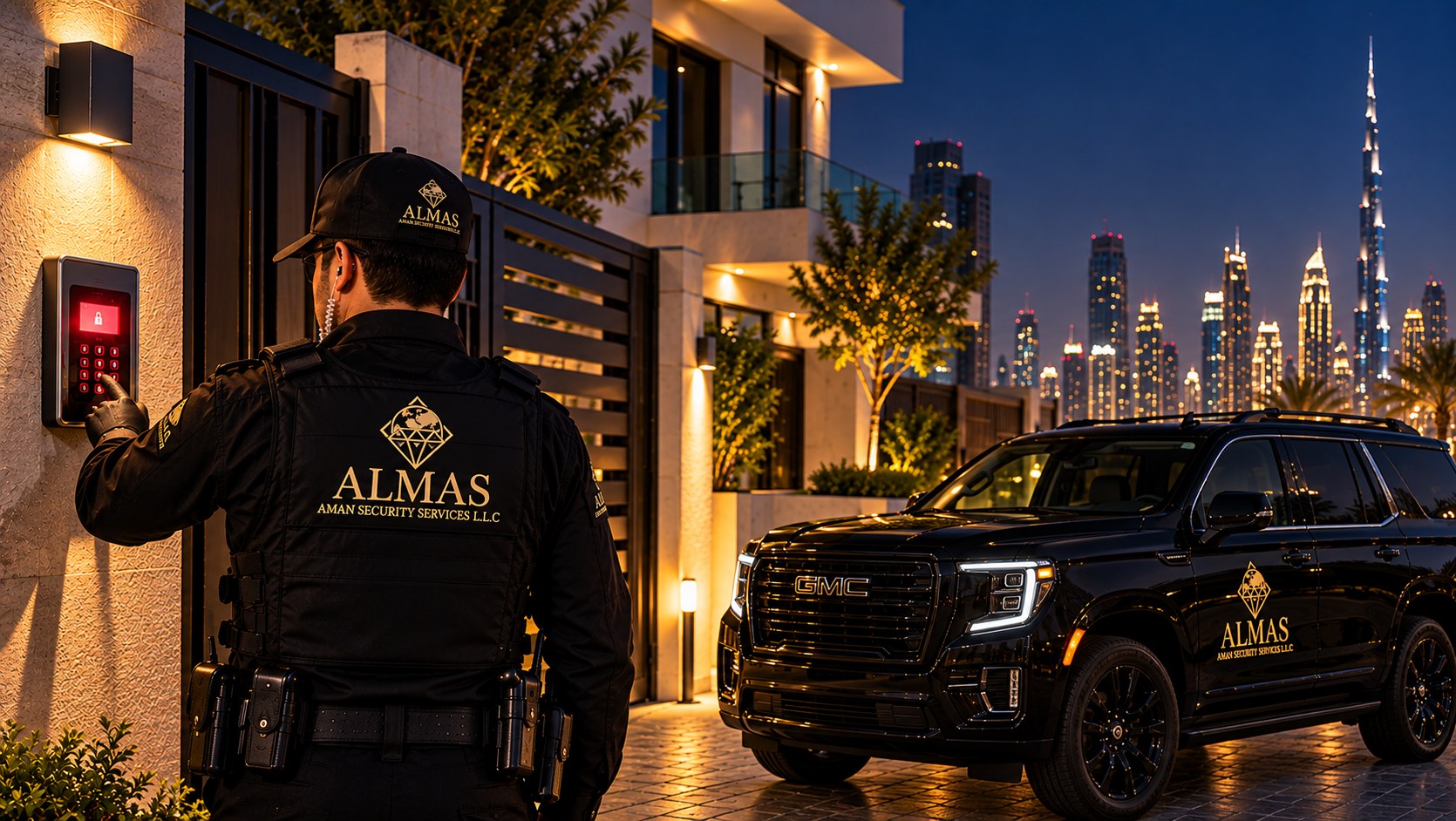
Keyholding and alarm response: what actually happens between the alarm and the guard
Most villa and small-business owners in Dubai have an alarm system and a monitoring subscription, and assume that when the alarm fires, someone handles it. That is partly true. What is less understood is the chain of events between the siren and the resolution, and who is legally allowed to do what at each step. Getting this chain wrong is how a 20-minute incident becomes a night of standing outside your own gate.
Who is allowed to respond, and who is not
In Dubai, private security functions are regulated. A person who attends an alarm activation as a security responder must be deployed by a licensed security company, trained and carded, and if they are to physically guard premises or people, they fall under SIRA licensing requirements. Your building handyman, your property manager’s maintenance crew, or a neighbour with a spare key can open a door, but they cannot lawfully act as a security responder, and no insurer will treat their attendance as a security response.
This is why keyholding is a service in its own right. The security company holds verified copies of your keys and access cards, logs every use, and dispatches a licensed responder. If you keep the keys yourself, then every activation is your problem, at whatever hour it fires.
The realistic timeline of an activation
A typical monitored alarm works like this. The panel triggers, the monitoring centre receives the signal within seconds to a couple of minutes, and an operator attempts verification: reviewing any camera feeds linked to the panel, calling the primary keyholder list. False alarms are the majority case, and verification exists to filter them.
If verification fails or footage shows movement, dispatch follows. Response times depend heavily on where you are. For a villa on the Palm or in Emirates Hills with a responder already patrolling the area, attendance inside 15 to 25 minutes is realistic. For a location that needs a dedicated dispatch from a distant post, 40 minutes to an hour is common, and on fog nights or during major events, longer. Anyone promising a fixed 10-minute response across all of Dubai is selling you a number, not an operation.
On arrival, the responder’s job is bounded: perimeter check, controlled entry with the held keys if instructed, walk-through of designated zones, then one of three call-outs, all-clear, false alarm with a reset, or a genuine incident which moves to police notification. The Dubai Police hotline for commercial alarm incidents and the CID process for suspected break-ins are the responder’s escalation path, not a decision made on your behalf beyond securing the scene.
What keyholding contracts should specify
When we quote keyholding and alarm response for a villa or a small office, these are the clauses that separate a real service from a paper one:
- Keys custody. Sealed, coded, in a safe, with a two-person rule for release and a written log of every deployment that used them.
- Named response protocol. Which zones the responder may enter, whether they enter when the cause is unknown, and explicit instruction on police call-outs.
- False alarm policy. How many resets are included, and what happens on repeated false activations, because panels that cry wolf get silently deprioritised by owners, which is exactly when the real one lands.
- Report within 24 hours. Every activation should end with a written incident report, times, actions, photos of any damage. If the contract is silent on reporting, you will find out what happened through your neighbours.
- Cover for the responder’s absence. Who attends when the rota has a gap. Single-responder arrangements fail exactly when the responder is on leave.
The parts owners get wrong
Three recurring problems come out of our incident reviews. First, contact lists that are years old: the monitoring centre calls a number that no longer belongs to anyone, verification fails, and the default becomes dispatch or ignore depending on the panel’s programming. Second, keys held by staff who left: the “spare key with the nanny or the driver” arrangement ends the moment employment does, and often nobody collects it. Third, panic buttons and app alerts configured on phones that are on silent overnight, which converts an instant notification into a morning surprise.
Cost, briefly
Ballpark figures for Dubai in 2026: monitored alarm and CCTV packages for a villa run from roughly AED 300 to 600 per month for monitoring alone. Keyholding with guaranteed attended response is typically quoted as a monthly retainer in the AED 800 to 1,500 range for villas, higher for larger compounds or 24/7 dedicated arrangements. Per-activation fees, usually AED 150 to 300, apply in some contracts after an included allowance. The number that matters more than any of these is the response-time commitment tied to a penalty or credit, because that is the only line in the contract the provider has to actually engineer for.
Where this fits in your wider setup
Keyholding is one layer. It assumes the physical security baseline of the property is sound: locks, lighting, camera coverage, and the daily presence arrangements described in our villa security quoting guide. A responder who arrives to a dark property with blind corners is doing detection work, not response work, and the incident reports will read accordingly.
If you hold your own keys today, one practical step costs nothing: write down, tonight, who would actually attend an activation at 3am, how they would get in, and what they are permitted to do. If the answer is unclear, that gap is your keyholding decision made for you.