
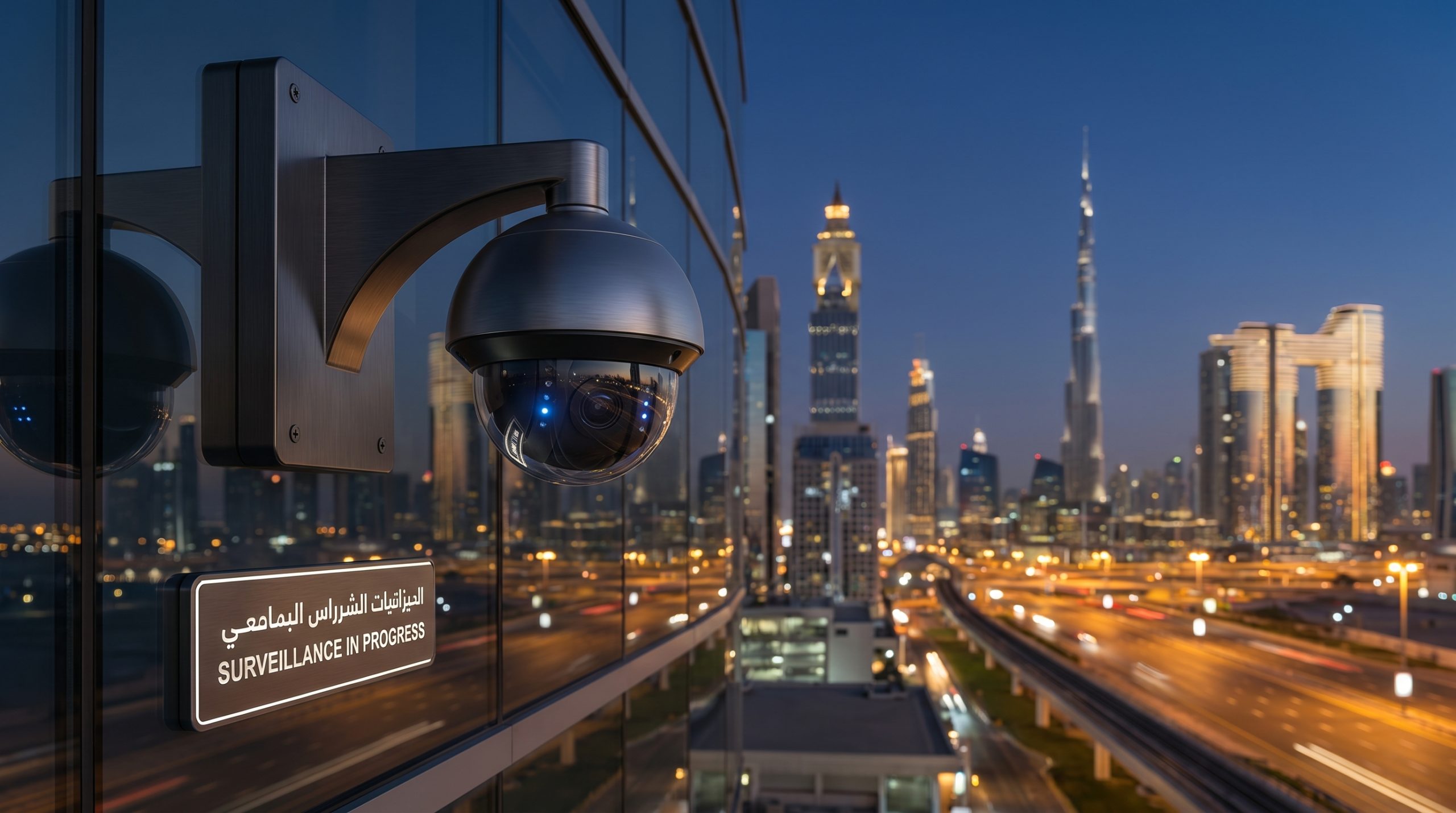
Security cameras are not optional in Dubai. They are mandatory.
SIRA Regulation 5.1 requires all licensed security companies to install CCTV systems that meet specific technical standards. Residential villas, commercial properties, and retail spaces in Dubai are increasingly required to demonstrate compliant surveillance as part of their security posture.
We assess security camera systems for clients across the UAE. The market is flooded with options ranging from consumer-grade Wi-Fi cameras to enterprise-class surveillance platforms. Most buyers overpay for features they do not need and underinvest in the components that actually matter.
Here is what decision-makers need to know about security cameras in Dubai.
The Regulatory Framework for CCTV in Dubai
Dubai Police and SIRA jointly regulate video surveillance through a structured framework. The two key documents are SIRA Standard 5.1 for commercial security providers and Dubai Police Resolution No. 24 of 2024 for private properties.
Mandatory requirements for commercial properties:
- Cameras must record at minimum 1080p resolution at 25 frames per second
- Footage retention period: 30 days minimum (90 days for government-adjacent facilities)
- Storage must be on-site or on a UAE-hosted server — no offshore cloud storage is permitted for covered facilities
- System must have battery backup capable of sustaining recording for at least four hours during a power outage
- All cameras must be registered with SIRA through the PSBD-compliant monitoring centre
Dubai’s Entertainment City and DIFC have additional overlay requirements. If your property falls under either jurisdiction, factor in an extra compliance layer before purchasing hardware.
Camera Types and Their Applications
The security camera market in Dubai breaks into four categories that matter for professional deployments.
Bullet cameras. These are the cylindrical units mounted on exterior walls. They are weather-resistant, provide long-range viewing, and dominate perimeter applications. Their visible design acts as a deterrent. For Dubai’s climate, look for IP67-rated housings that can handle sustained 50°C temperatures and the occasional sandstorm.
Dome cameras. The standard choice for interior surveillance in Dubai offices, retail spaces, and hotel lobbies. Their low-profile design makes it difficult for subjects to determine the camera’s direction of focus. Dome cameras are less susceptible to tampering than bullet cameras and integrate better with architectural finishes.
PTZ cameras (pan-tilt-zoom). These are the workhorses of active surveillance. A single PTZ camera can cover the area of four fixed cameras. They are appropriate for large parking areas, construction sites, and warehouse facilities. The trade-off is mechanical wear — PTZ units have moving parts that require maintenance in Dubai’s dusty environment.
Thermal and multi-sensor cameras. An emerging category gaining traction in Dubai’s high-security sector. Thermal cameras detect body heat signatures regardless of lighting conditions. Multi-sensor units combine optical, thermal, and LIDAR data into a single surveillance stream. These systems are expensive — expect to pay AED 15,000–45,000 per unit — but they eliminate blind spots that conventional cameras cannot cover.
Resolution and Image Quality Standards
The common assumption is that more megapixels equal better security. This is incorrect in practice.
SIRA mandates 1080p minimum, and most commercial deployments spec 4MP or 5MP cameras. Going beyond 8MP introduces trade-offs:
- Higher resolution requires proportionally more storage. An 8MP camera at 25fps generates roughly 300GB of footage per day. A 2MP camera doing the same work generates 80GB.
- Night performance degrades as pixel density increases. A 2MP camera with a large sensor will outperform an 8MP camera with a small sensor in low-light conditions — which is most of Dubai’s operational recording window after sunset.
- License plate recognition (LPR) and facial recognition require specific sensor-to-object ratios, not just raw resolution. A 2MP LPR camera positioned at the correct choke point will capture plates that an 8MP general-purpose camera misses.
Our recommendation for most properties: spec 4MP for perimeter coverage, 2MP with wide dynamic range for interior zones, and dedicated LPR or ANPR cameras for entry and exit points.
Storage Architecture and Data Retention
The 30-day retention requirement is the baseline. Smart property managers budget for 60 days.
NVR versus DVR. Network Video Recorders (NVRs) work with IP cameras and should be the default choice for any new installation. Digital Video Recorders (DVRs) use coaxial cable and analogue cameras — these are legacy systems that should only be considered for retrofit projects where pulling new cable is cost-prohibitive.
Storage calculation. For a 16-camera system at 4MP recording 24/7:
- H.265 compression: approximately 3.5TB for 30 days
- H.264 compression: approximately 6TB for 30 days
- Estimated hardware cost: AED 1,500–3,000 for the NVR (excluding hard drives)
Use enterprise-grade surveillance hard drives (Western Digital Purple or Seagate SkyHawk series). Consumer desktop drives fail within 12–18 months in continuous-write environments.
Cloud storage. SIRA restricts cloud storage for camera feeds on covered commercial sites. This does not apply to residential villa installations, but any cloud service must demonstrate UAE data sovereignty. Providers like Backblaze and AWS UAE Local Zone meet this requirement. Google Cloud and AWS Bahrain do not.
Installation Considerations Specific to Dubai
Dubai’s built environment creates installation constraints that do not apply in temperate climates.
Heat management. Camera housings exposed to direct sunlight can reach internal temperatures of 70°C. Most consumer-grade cameras are rated to 45–50°C ambient. The result is thermal shutdown during June through September. Specify cameras with a rated operating range of at least –10°C to 60°C, and install them under eaves or shades where possible.
Cable routing. Dubai’s post-2015 buildings typically have dedicated CCTV conduit runs installed during construction. Pre-2010 buildings often do not. Retrofitting cable through concrete walls with 40cm thickness requires core drilling and professional finishing. Budget accordingly — cable routing labour in Dubai runs AED 150–250 per drop for finished interiors.
Wi-Fi cameras are not suitable for perimeter security. The wireless spectrum in Dubai’s dense residential and commercial towers is congested. A single Wi-Fi camera may perform adequately. Ten cameras on the same wireless network will experience packet loss, latency, and dropped feeds — and this is before accounting for interference from the dozen other Wi-Fi networks operating on adjacent channels in your building.
Maintenance and Compliance Audits
SIRA conducts periodic inspections of registered surveillance systems. Non-compliance triggers a notice period followed by fines.
Common findings during SIRA audits:
- Cameras repositioned during renovations without recalibration
- Storage systems running at 80%+ capacity (below 30-day retention threshold)
- Firmware versions two or more years behind current release
- Missing or outdated PSBD monitoring centre integration
We recommend quarterly maintenance inspections. Each inspection should verify recording integrity, storage headroom, and firmware compliance. The cost of a quarterly inspection contract in Dubai ranges from AED 800–2,500 per site visit depending on system size.
Final Recommendation
A well-designed CCTV system in Dubai is not about buying the most expensive cameras. It is about matching equipment to regulatory requirements, environmental conditions, and actual operational needs.
Start with a security risk assessment of your property. Define which zones require detection versus identification versus monitoring. Then spec the cameras, storage, and infrastructure to match — not the other way around.
At Almas Aman, we conduct independent security assessments that include CCTV system audit and specification. If you are planning a new installation or upgrading an existing system, contact us for a site survey.