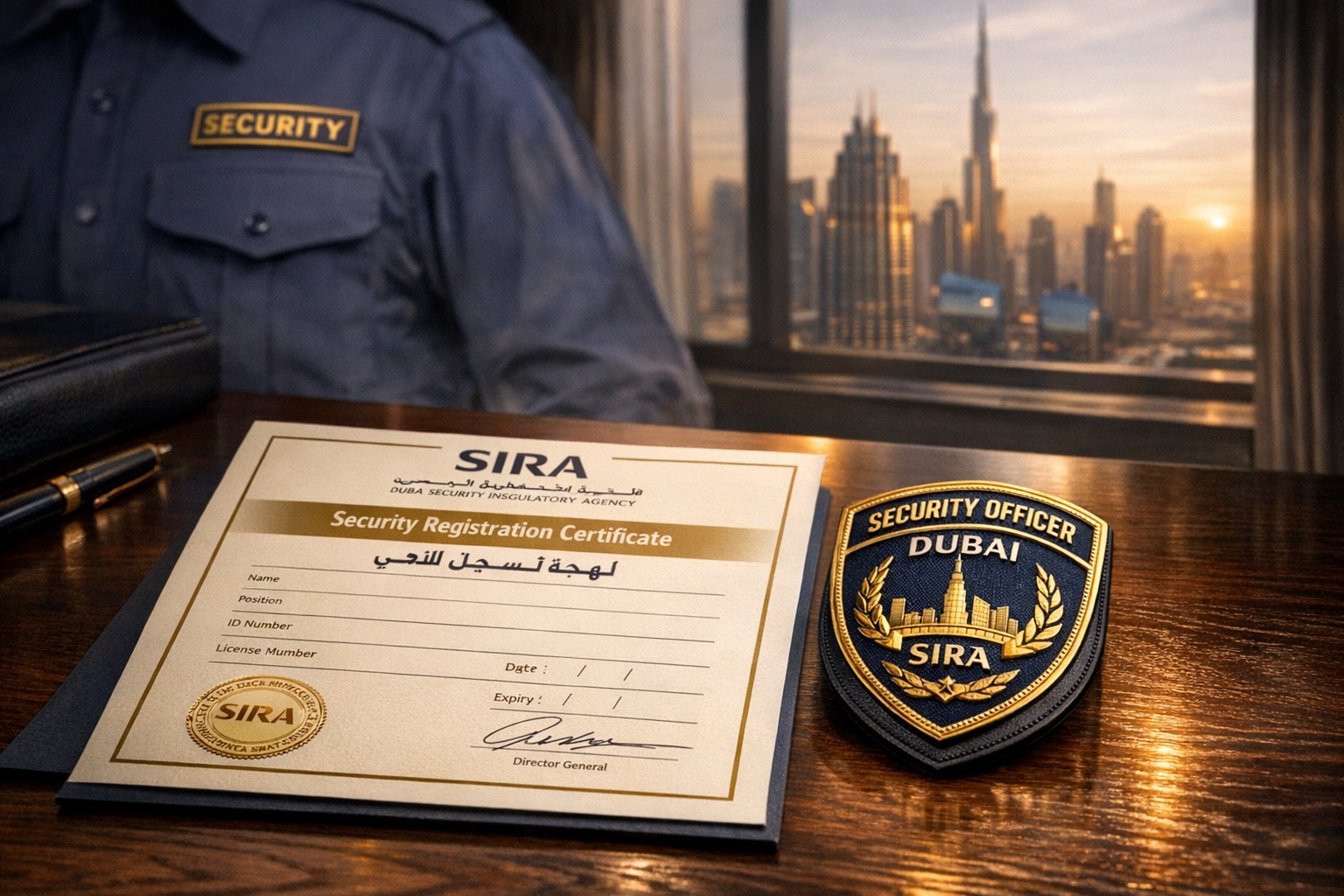
Operating a private security business in Dubai involves more than obtaining a commercial trade licence. Security activities are regulated by the Security Industry Regulatory Agency (SIRA), and companies must meet the requirements applicable to the specific security activities they intend to provide.
SIRA is the Dubai government entity responsible for regulating the security industry in the Emirate. Its responsibilities include establishing security standards and requirements, licensing regulated security activities and personnel, and overseeing compliance within the sector.
For security companies, this means SIRA compliance should be treated as an ongoing operational requirement rather than simply a one-time licensing exercise.
Security Activity Licensing
A company intending to conduct a regulated security activity in Dubai must obtain the relevant approvals and security activity licence applicable to that activity.
SIRA maintains requirements for different security activities, and these requirements are not identical across every type of security business. Depending on the activity, a company may need to provide specific personnel, documentation, facilities, technical approvals or other supporting requirements.
The process is therefore determined by the actual security activity being licensed.
SIRA’s current service process for a new security activity licence includes registration on the SIRA e-services portal, submission of the relevant application and documents, payment of the applicable fees, and completion of the requirements associated with the particular security activity.
Companies should not assume that approval for one security activity automatically permits them to undertake another.
Security Personnel Licensing
SIRA also regulates individuals working in professions connected with Dubai’s private security sector.
Security personnel must hold the appropriate Security Cadre Licence for the role they perform. SIRA publishes different categories and requirements depending on the position.
Requirements can include items such as:
- Emirates ID;
- valid UAE residency;
- a Dubai Police good conduct certificate addressed to SIRA;
- completion of the applicable course at an approved training centre;
- qualifications or experience for certain specialist or senior positions; and
- any additional conditions prescribed for the particular security role.
The exact requirements therefore need to be checked against the relevant SIRA personnel category rather than applying one standard checklist to every employee.
SIRA currently states that a Security Cadre Licence is valid for two years, subject to the applicable conditions.
Employment and Residency Requirements
Personnel licensing is closely connected to employment and residency status.
Under SIRA’s published conditions, security personnel generally need to be sponsored by the company for which they work. SIRA also requires the profession stated in the individual’s residency records to correspond with the security personnel licence.
There are specific provisions for security companies operating branches in other Emirates under the same trade name, so businesses operating across the UAE should check the requirements applicable to their particular structure.
Companies should verify these matters before deploying personnel rather than discovering a licensing incompatibility after an employee has already been assigned to a security function.
Training and Qualification
Training requirements depend on the security role.
SIRA recognises approved security training centres and prescribes qualification requirements for various categories of security personnel. Some positions require specific courses, examinations, professional experience or academic qualifications.
For this reason, companies should confirm the current SIRA requirement for the exact position before arranging training or submitting a personnel licensing application.
Training completed for one category should not automatically be assumed to satisfy the requirements of another category.
Maintaining Company Compliance
Obtaining a security activity licence is not the end of a company’s regulatory responsibilities.
Security companies should maintain accurate records of their licensed activities and personnel and monitor licence validity and renewal requirements.
As a practical internal control, companies should regularly verify:
- that the security activities being provided fall within the company’s approved licensing scope;
- that personnel performing regulated duties hold the appropriate valid SIRA licence;
- that residency and employment information remains consistent with licensing requirements;
- that required training and qualifications remain current;
- that changes to personnel or business activities are reflected in the appropriate SIRA processes; and
- that outstanding regulatory requirements, dues, fines or penalties are addressed before renewal where applicable.
These checks help reduce the risk of operational or administrative gaps developing as the business grows.
Changes to Security Personnel
Security companies should also maintain proper controls when licensed personnel leave the organisation.
SIRA’s published conditions state that when the employment of licensed security personnel ends, the security manager must withdraw the individual’s card and submit the appropriate cancellation request through the SIRA e-services portal.
This makes employee offboarding an important part of security compliance, not merely an HR procedure.
Licence Renewal
Security activity licences and personnel licences need to be monitored before expiry.
For security activity licence renewal, SIRA requires companies to complete the applicable renewal process and satisfy the requirements associated with their licensed activities. SIRA also states that outstanding dues, fines or penalties must be settled before renewal.
Personnel licences likewise have their own renewal procedures and requirements.
Companies should therefore maintain a central licence register containing expiry dates and supporting documentation rather than relying on individual employees to monitor their own regulatory status.
Requirements Vary by Security Activity
One of the most important points for security businesses is that there is no single SIRA checklist covering every security activity.
Requirements vary according to the service being provided and may involve specific personnel, facilities, technical conditions or external approvals.
A company considering a new service should therefore check the relevant SIRA activity requirements before offering or commencing that service.
This is particularly important when expanding into a security activity that is different from those already shown on the company’s existing approvals and trade licence.
The 2026 Regulatory Framework
Dubai’s security-industry regulatory framework continues to develop.
In 2026, a new implementing regulation was issued under Dubai Law No. 12 of 2016 concerning the regulation of the security industry in the Emirate of Dubai.
Security companies should therefore rely on current SIRA requirements and current Dubai legislation rather than assuming that older procedures, guidance or licensing practices remain unchanged.
Where a regulatory requirement is unclear, confirmation should be obtained from SIRA or the relevant competent authority before acting.
Practical Compliance Approach for Security Companies
For day-to-day operations, a sensible compliance system should connect four areas:
Company licensing — Are the services being provided covered by the company’s approved security activities?
Personnel licensing — Does each person performing a regulated security function hold the correct and valid licence?
Training and qualifications — Have personnel completed the requirements applicable to their particular role?
Ongoing administration — Are renewals, cancellations, employee changes and regulatory records being properly maintained?
Keeping these areas aligned helps a security company demonstrate that its commercial operations match its regulatory permissions.
Conclusion
SIRA compliance is a fundamental part of operating a security business in Dubai.
Companies need to ensure that their licensed activities, personnel, training and ongoing administrative processes remain aligned with current SIRA requirements. Because requirements differ according to the security activity and personnel category, businesses should always check the current requirements applicable to their specific circumstances.
For the latest requirements, applications and service information, companies should refer directly to the Security Industry Regulatory Agency’s official channels and e-services.