What SIRA Licensing Actually Means When Hiring Security in Dubai
If you are hiring private security in Dubai, every company will tell you they are “licensed.” The word appears on websites, proposals, and business cards. But not all licenses mean the same thing, and the difference between a properly SIRA-licensed operation and one that is technically registered but cutting corners shows up the moment something goes wrong.
Here is what SIRA licensing actually covers, what it does not, and the questions worth asking before you sign a contract.
What SIRA is and why it matters
The Security Industry Regulatory Authority (SIRA) is the Dubai government body responsible for regulating the private security industry. It sets training standards, issues individual guard licenses, approves security companies, and conducts audits. Every private security guard working legally in Dubai must hold a valid SIRA license. Every company providing guarding services must hold a SIRA company license.
This is not a rubber-stamp process. SIRA-licensed guards complete a mandatory training program covering physical intervention, emergency response, legal powers, and customer service. They pass a written exam and a physical fitness test. Their licenses are renewed periodically, and SIRA maintains a record of each individual guard, linked to their employer.
If you hire guards through a company that is not SIRA-licensed, you are using unlicensed personnel. That creates two problems. First, it is illegal – Dubai Municipality and SIRA conduct inspections, and penalties apply to the client as well as the provider. Second, if a guard without a SIRA license uses force or makes an error during an incident, the legal liability falls squarely on you as the client. Insurance does not cover unlicensed operations.
Company license versus individual license
A common gap: a company holds a SIRA company license but deploys guards whose individual licenses have lapsed or were never issued. This happens with smaller outfits that rotate staff quickly or subcontract to cheaper providers without verifying credentials.
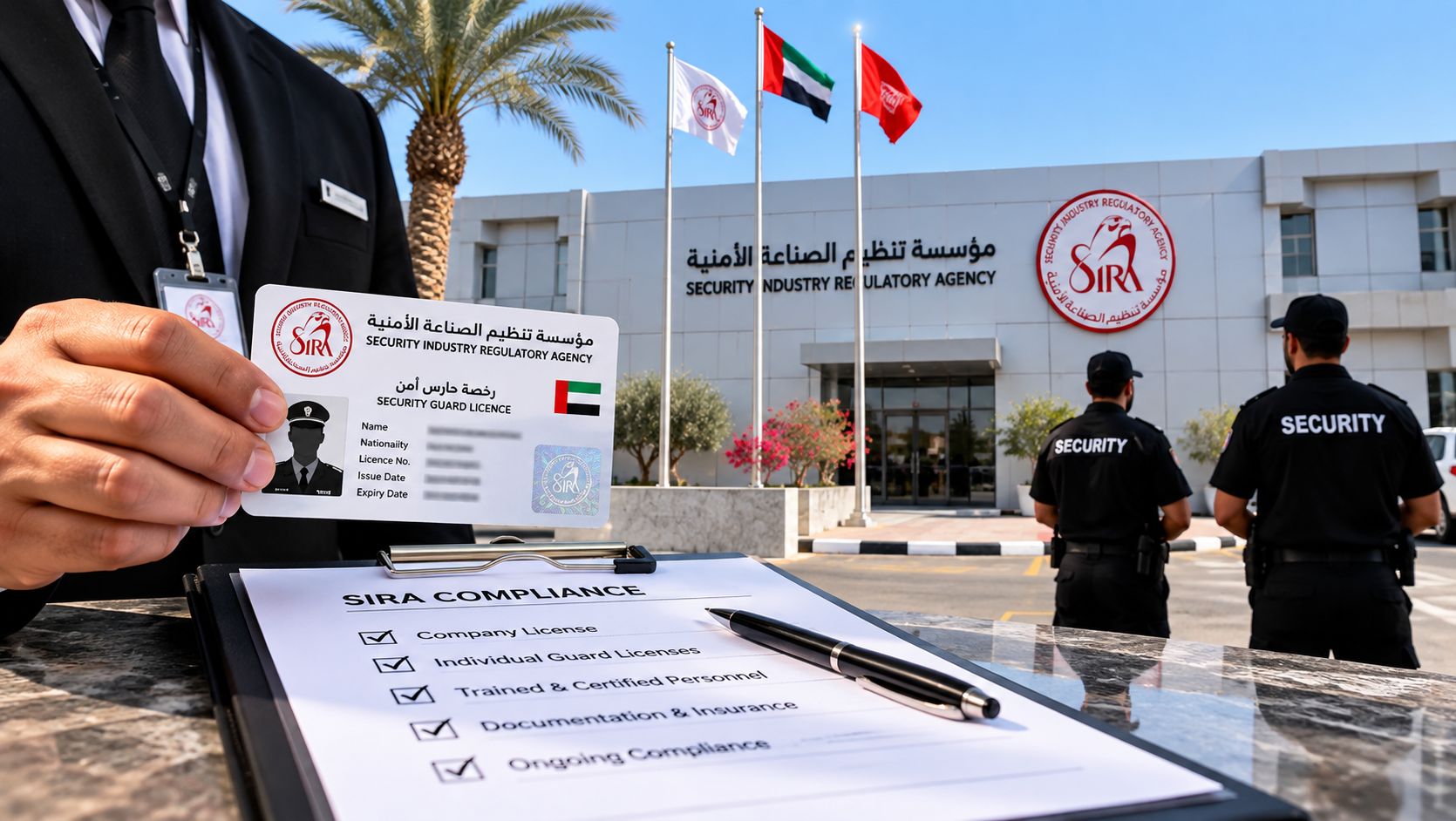
When evaluating a security provider, ask for two things: the company’s SIRA certificate (which confirms the firm is approved to operate) and the individual SIRA license numbers of the specific guards assigned to your site. You can verify individual licenses through SIRA’s verification system using the license number printed on the guard’s card.
A company that cannot produce individual license numbers for the guards they plan to deploy is a red flag. The answer should be immediate – if they need to “get back to you,” the guards may not be licensed yet.
What SIRA licensing does not cover
SIRA licensing means the guard is trained and legally authorized to work. It does not mean they are trained for your specific security needs. A guard licensed for residential gate duty is not automatically qualified for close protection work with a high-profile principal. The SIRA curriculum covers fundamentals – access control, patrol procedures, incident reporting, basic physical intervention. Specialist skills like executive protection, threat assessment, and secure driving are additional qualifications that sit on top of the SIRA baseline.
This is where the distinction between a guarding company and a specialist protection firm matters. A guarding company provides SIRA-licensed bodies for posts. A specialist firm layers trained, experienced operators on top of that licensing foundation – people who have done close protection work before, who understand advance planning, route reconnaissance, and principal management.
For more on how structured, intelligence-led deployments differ from standard guarding, our executive and close protection service page breaks down the full engagement model.
The four questions that separate real operators from paperwork companies
During a procurement process, these questions surface the gaps quickly:
1. Who exactly will be on my site, and can I see their credentials before deployment? A proper firm provides a team profile with each member’s experience, qualifications, and SIRA license number. If the answer is “we will assign someone closer to the date,” the company is staffing reactively, which means you are getting whoever is available, not whoever is right for the job.
2. What is your escalation structure? Who does the on-site guard call when something happens? Is there a duty supervisor available 24/7? Is there an operations manager who can make decisions in real time? A one-man company with a SIRA license and a phone number is not an escalation structure.
3. Can you walk me through a recent incident and how your team handled it? This is not about confidentiality – they can anonymize the details. It is about whether the company has a method. If the answer is vague or theoretical, they have not been tested.
4. What is your vetting process for personnel? SIRA licensing is the legal minimum. Background checks, reference verification, and ongoing performance review are what differentiate professional firms. Ask specifically about criminal background screening and employment history verification.
Cost differences and what drives them
SIRA-licensed guarding in Dubai typically runs between AED 2,500 and AED 4,500 per guard per month, depending on the role, hours, and specialization. Close protection operators command significantly more – AED 8,000 to AED 15,000+ per month per operator, reflecting the additional training, experience, and clearance level required.
If a quote comes in well below the market range, something is being cut. Usually it is training, supervision, or the guard-to-post ratio (one guard covering two posts). Sometimes it is the SIRA license itself – unlicensed guards cost less because the company is not paying licensing fees, training costs, or insurance.
The cheapest option in security is consistently the most expensive in practice. Turnover is high, incident response is slow, and when something does go wrong, the legal exposure falls on the client.
Documentation that should accompany any contract
A professional security contract in Dubai should include: the company’s SIRA license number, the specific guards assigned (by name and SIRA license number), a deployment schedule, an escalation protocol with named contacts, insurance coverage details, and a service-level agreement covering response times. If any of these are missing, the engagement is informal – and informal security arrangements do not hold up when scrutinized after an incident.
For high-value residential or corporate deployments, a documented risk assessment should precede the contract. This identifies threats specific to your location, building, or profile and shapes the deployment accordingly. Standardized guarding without a risk assessment is a post-filling exercise, not a security program. Our corporate and residential security overview covers how that assessment process works in practice.
The bottom line
SIRA licensing is the floor, not the ceiling. It confirms that a company and its guards are legally authorized to operate in Dubai. It does not confirm that the company can handle your specific security requirements. The difference between a firm that holds a license and a firm that operates to a professional standard comes down to supervision, specialist training, documented procedures, and the caliber of people they deploy. Ask the questions. Verify the credentials. And choose based on capability, not just price.